
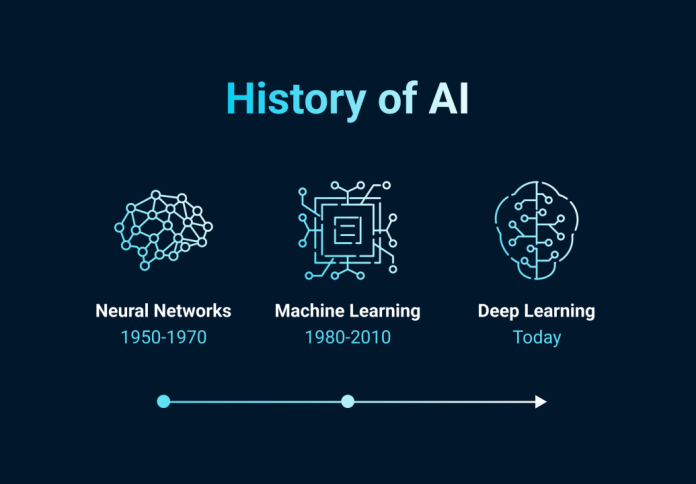
Artificial Intelligence History & Evolution
Artificial Intelligence (AI) has come a long way from its conceptual beginnings to the powerful, game-changing technology it is today. While many think AI is a modern concept, its historical background dates back to early discussions on automated reasoning and machine intelligence.
In this article, we’ll explore the historical development of artificial intelligence, AI historical data types, explainable AI, and how AI is being used to recreate historical sites. We will also look at how AI is revolutionizing the study of historical artificial intelligence figures, historic paintings, and the evolution of AI itself. This will provide a comprehensive view of the artificial intelligence history and evolution.
What is Artificial Intelligence?
Artificial Intelligence refers to the development of computer systems capable of mimicking human cognitive functions such as learning, reasoning, and problem-solving. AI is now used in industries ranging from healthcare and finance to art restoration and history preservation.
Artificial Intelligence History & Evolution
The idea of machines thinking like humans dates back centuries. However, AI as a formal field began in the mid-20th century. Let’s take a look at its origins and the history and evolution of artificial intelligence.
Early Foundations of AI (1900-1950)
| Year | Milestone |
|---|---|
| 1921 | The term “robot” was introduced in the play “Rossum’s Universal Robots.” |
| 1943 | Warren McCulloch and Walter Pitts developed the first neural network model. |
| 1950 | Alan Turing proposed the Turing Test, a method to evaluate machine intelligence. |
The Emergence of AI (1950-1973)
Between 1950 and 1973, researchers began to develop explainable artificial intelligence and experimental AI programs.
Key Milestones in AI Development:
- 1956: John McCarthy coined the term “Artificial Intelligence” at the Dartmouth Conference.
- 1957: Frank Rosenblatt introduced the Perceptron, an early neural network.
- 1966: Joseph Weizenbaum created ELIZA, a chatbot that simulated human conversation.
AI Winters (1974-1980 & 1987-1993)
Despite early enthusiasm, AI research faced funding cuts due to unrealistic expectations. These periods, known as “AI Winters,” saw limited progress due to high costs and slow computational power.
Understanding AI Funding and Development
The AI Boom and Advancements (1980-2011)
The resurgence of AI in the 1980s and early 2000s led to remarkable breakthroughs, contributing significantly to the history and evolution of artificial intelligence.
Historical Advancements in Artificial Intelligence:
| Year | Milestone |
|---|---|
| 1980 | Expert Systems like XCON became commercially viable. |
| 1997 | IBM’s Deep Blue defeated chess champion Garry Kasparov. |
| 2000 | NASA deployed autonomous AI rovers to Mars. |
| 2011 | Apple introduced Siri, the first mainstream AI voice assistant. |
Modern AI: 2012-Present
The last decade has seen AI integrate into daily life and business. With breakthroughs in machine learning, deep learning, and large-scale data processing, AI has moved beyond theoretical applications.
Key AI Milestones Since 2012:
- 2012: Google’s AI recognized images of cats without prior training.
- 2016: Hanson Robotics introduced Sophia, a humanoid AI robot.
- 2020: OpenAI launched GPT-3, a generative language model.
- 2023: AI-powered multimodal models can now process text, images, and audio.
Artificial Intelligence in Historical Data & Preservation
AI is now playing a crucial role in analyzing historical artificial intelligence data training data and recreating historical sites and paintings.
1. AI in Analyzing Historical Data
- AI can scan, translate, and digitize ancient manuscripts.
- Historic paintings artificial intelligence photo matcher tools identify and restore faded art.
- Historical data artificial intelligence rate analysis helps predict past events with AI modeling.
2. AI Recreating Historical Figures & Paintings
AI has been used to recreate historical figures from paintings, such as bringing Da Vinci’s Mona Lisa to life using deepfake technology.
3. AI in Historical Site Restoration
How artificial intelligence is being used to recreate historical sites:
- AI reconstructs ruined architecture through 3D modeling.
- AI-based image restoration algorithms bring old photographs back to life.
- Machine learning predicts how historical sites looked before their destruction.
Explore AI in Historical Preservation
The Future of Artificial Intelligence
The history and evolution of artificial intelligence is shaping the future of automation, robotics, and data analysis. Some trends to watch include:
1. AI in Education
- AI-driven virtual tutors personalize learning experiences.
- Historical perspective of explainable artificial intelligence is being introduced in academic curriculums.
2. AI in Business & Healthcare
- AI is automating legal and financial analysis.
- AI is advancing predictive healthcare models.
3. AGI & Beyond
- Scientists are working on Artificial General Intelligence (AGI), an AI that thinks like humans across all tasks.
Conclusion
The history and evolution of artificial intelligence has seen highs and lows, from AI winters to AI booms. Today, AI is used in fields ranging from healthcare and finance to art and history preservation.
With AI now recreating historical sites and figures, analyzing historical data, and revolutionizing art restoration, its potential is limitless. Whether you’re a tech enthusiast, historian, or business leader, AI is shaping the world in ways we never imagined.
Stay updated with AI advancements
Learn about What is Artificial Intelligence
Key Takeaways:
✅ AI dates back to the early 20th century. ✅ AI has faced setbacks (AI Winters) but continues to evolve. ✅ AI is now recreating historical sites and paintings. ✅ AGI and machine learning will shape the future.