
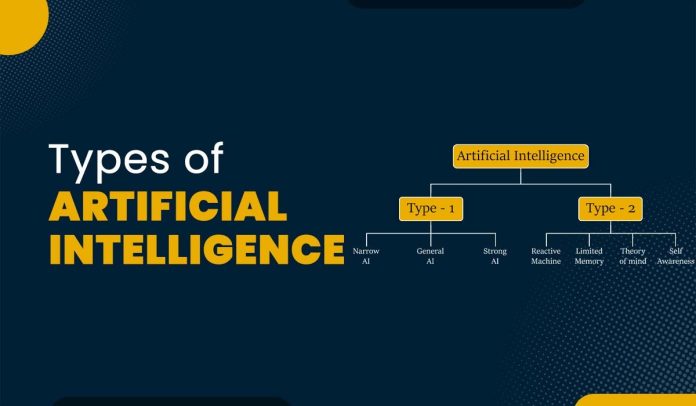
Types of Artificial Intelligence
Types of Artificial Intelligence: A Comprehensive Guide
Introduction to Artificial Intelligence
Artificial Intelligence (AI) is revolutionizing industries by enabling machines to perform human-like tasks. These AI systems improve efficiency, accuracy, and automation, making them indispensable in today’s world. AI can be classified into different types based on capabilities and functionality.
This article will explore the types of artificial intelligence, artificial intelligence types, and 5 main types of artificial intelligence, including real-world examples and applications.
Learn more about AI from the official documentation
Types of Artificial Intelligence Based on Capabilities
AI can be categorized into three types based on its ability to replicate human intelligence:
1. Narrow AI (Weak AI)
Narrow AI, also known as Weak AI, is designed to perform a specific task with intelligence. These systems lack self-awareness and cannot perform beyond their programmed capabilities.
Examples of Narrow AI:
- Voice Assistants: Apple Siri, Amazon Alexa, Google Assistant
- Recommendation Engines: Netflix, YouTube, Spotify
- Facial Recognition Systems: Security authentication in smartphones
2. General AI (Strong AI)
General AI, or Strong AI, refers to an AI system that can perform any intellectual task like a human. It has the ability to learn, adapt, and make independent decisions.
Potential Applications:
- Fully autonomous robots
- AI-powered virtual humans
3. Super AI
Super AI refers to AI that surpasses human intelligence, making decisions autonomously without human intervention. It can think, reason, and even develop emotions.
Super AI is a hypothetical concept, but if achieved, it could revolutionize every industry.
Read more about AI Capabilities
Types of Artificial Intelligence Based on Functionality
AI can also be categorized based on how it functions and learns from data.
1. Reactive Machines
Reactive AI is the most basic form of AI, which operates only on present data. It does not store past experiences or learn from them.
Examples:
- IBM’s Deep Blue: Chess-playing AI that defeated Garry Kasparov
- Google’s AlphaGo: A board-game AI that uses pattern recognition
2. Limited Memory AI
Limited Memory AI stores past experiences and makes predictions based on historical data.
Examples:
- Chatbots: Remember past interactions for better responses
- Self-Driving Cars: Use sensor data, road conditions, and past driving experiences to navigate
3. Theory of Mind AI
Theory of Mind AI is an advanced form of AI that understands human emotions, beliefs, and social interactions.
Potential Applications:
- Socially interactive robots
- AI companions for elderly care
4. Self-Aware AI
Self-Aware AI represents the future of AI, where machines possess consciousness and self-awareness.
Potential Applications:
- Ethical decision-making AI
- Fully autonomous AI-driven societies
Different Types of Artificial Intelligence Systems
There are multiple types of AI systems, each with its own functionality.
1. Types of Generative Artificial Intelligence
Generative AI refers to AI models that create new content, such as text, images, and music.
Examples:
- GPT-4: Generates human-like text
- DALL·E: Creates AI-generated artwork
- DeepFake: Modifies video and audio content
2. Types of Artificial Intelligence Algorithms
AI algorithms form the backbone of AI systems. Some of the most commonly used AI algorithms include:
- Supervised Learning Algorithms: Used for classification and regression tasks
- Unsupervised Learning Algorithms: Used for clustering and anomaly detection
- Reinforcement Learning: Used in robotics and gaming
3. Types of Learning in Artificial Intelligence
AI systems learn using different machine learning techniques:
- Supervised Learning: Uses labeled data
- Unsupervised Learning: Finds patterns without labels
- Reinforcement Learning: Learns through rewards and punishments
4. Types of Artificial Intelligence in Healthcare
AI is transforming healthcare by improving diagnostics, drug discovery, and patient care.
Applications of AI in Healthcare:
- AI-powered medical imaging (X-ray, MRI analysis)
- Predictive healthcare models
- AI chatbots for mental health support
How Many Types of Agents are Defined in Artificial Intelligence?
AI agents are classified into different types based on how they interact with their environment:
- Simple Reflex Agents – React based on pre-defined rules
- Model-Based Agents – Use internal knowledge to make decisions
- Goal-Based Agents – Take actions to achieve specific goals
- Utility-Based Agents – Optimize for the best possible outcome
- Learning Agents – Continuously improve performance based on experience
Comparison: 2 Types vs. 3 Types vs. 5 Types of Artificial Intelligence
| Number of AI Types | Description |
|---|---|
| 2 Types of AI | Narrow AI, General AI |
| 3 Types of AI | Narrow AI, General AI, Super AI |
| 5 Types of AI | Reactive AI, Limited Memory AI, Theory of Mind AI, Self-Aware AI, Super AI |
Conclusion
Artificial Intelligence is transforming industries and everyday life. Understanding the different types of artificial intelligence, artificial intelligence algorithms, and AI systems helps in utilizing AI efficiently.
To summarize: ✅ AI can be classified based on capabilities (Narrow AI, General AI, Super AI) ✅ AI can be classified based on functionality (Reactive AI, Limited Memory AI, etc.) ✅ Generative AI, AI algorithms, and AI learning types shape different AI models ✅ AI is playing a significant role in healthcare, automation, and robotics
As AI continues to evolve, its applications will expand, impacting every industry globally.
Stay updated with AI developments
Learn about Artificial Intelligence History & Evolution