
SOC best practices for cloud 2026
Advanced Operational Frameworks and SOC Best Practices for Cloud-Native Security
The security operations landscape has reached a definitive tipping point in late 2025. For enterprise architects across the US and UK, the traditional Security Operations Center is undergoing a forced evolution. As cloud intrusions have surged by over 75% in the last twelve months, the mandate to implement SOC best practices for cloud has shifted from a compliance checkbox to a fundamental requirement for business continuity. Adversaries are no longer just knocking at the perimeter; they are exploiting the foundational layers of cloud infrastructure, compressing the time between initial access and lateral movement to less than three minutes. This week, we are seeing a massive spike in search intent as organizations scramble to secure agentic AI workflows and defend against hyper-personalized extortion scams that bypass traditional multi-factor authentication.
The core business pain point centers on the “breakout time” bottleneck. In a traditional environment, defenders had days to react. In the modern cloud-native ecosystem, an attacker can exfiltrate an entire S3 bucket or compromise a Kubernetes cluster before an L1 analyst even clears their initial queue. This reality is driving the rapid adoption of autonomic security operations, where the goal is to move beyond manual triage into a model of supervised autonomy. By unifying identity signals with workload telemetry, senior architects are finally able to close the visibility gaps that have historically plagued multi-cloud environments, turning the security operations center into a proactive engine of cyber resilience rather than a reactive cost center.
Technical Architecture of a High-Performance Security Operations Center
A modern cloud-native SOC architecture must be built to ingest and normalize telemetry at an exabyte scale. Unlike legacy SIEMs that were hamstrung by events-per-second licensing and hardware constraints, today’s high-performance security data lakes leverage the infinite elasticity of the cloud. The internal working of this system begins with a sophisticated telemetry pipeline that draws from AWS CloudTrail, Azure Activity Logs, and GCP Audit Logs. This data is not merely stored; it is normalized into a Unified Data Model (UDM) at the point of ingestion. Normalization is the secret sauce of modern SOC best practices for cloud, ensuring that an “access denied” event in a containerized microservice is indexed identically to a suspicious login on a legacy SaaS application.
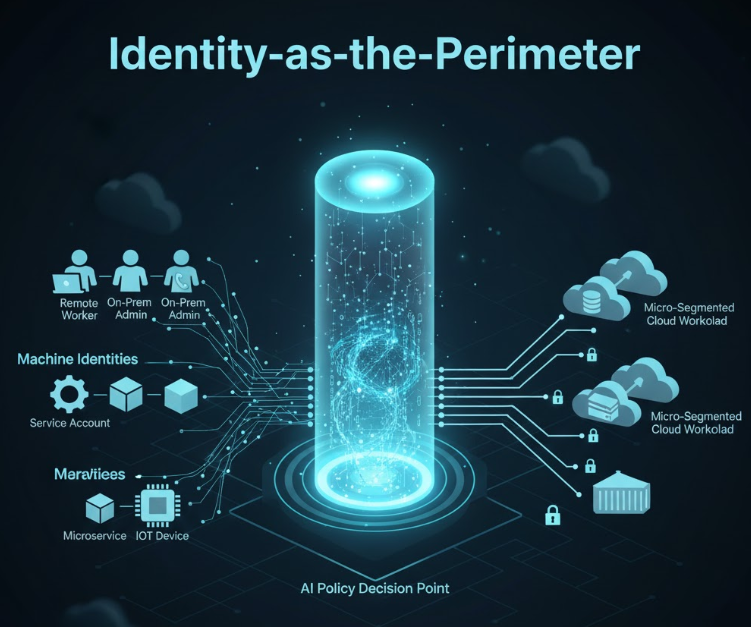
The structure depends on a clear separation between the control plane and the data plane. The control plane acts as the brain, housing the AI-driven policy engine that calculates real-time risk scores for every request. If a request is made to a sensitive production database, the engine evaluates the trust context—analyzing the user’s identity, the device’s health posture, and current threat intelligence. Only when the trust score exceeds a predefined threshold is the data plane allowed to facilitate the connection. This identity-aware proxy model eliminates the need for legacy VPNs, which often create dangerous blind spots and performance bottlenecks in distributed UK and US workforces.
Real-World Use Cases Across AWS, Azure, and Google Cloud
In the AWS ecosystem, the implementation of a comprehensive cloud security operations center strategy typically revolves around a multi-account landing zone model. Large-scale enterprises use AWS Organizations to enforce Service Control Policies that act as high-level guardrails. A common engineering pattern involves the deep integration of AWS GuardDuty with Security Hub. For example, a global retail giant might use serverless Lambda functions to trigger an automated incident response when GuardDuty detects a reverse shell on an EKS node. By automating the isolation of compromised containers, the SOC reduces the blast radius of a breach from hours to seconds, a core tenet of modern SOC best practices for cloud.
Microsoft Azure remains the dominant choice for organizations heavily invested in the Microsoft 365 stack. The Azure framework anchors its security on Microsoft Entra ID, treating identity as the primary security perimeter. In financial services, we often see the implementation of conditional access policies that require phishing-resistant MFA whenever a high-risk sign-in is detected by Microsoft Sentinel. Sentinel’s commitment tiers allow for predictable scaling, enabling teams to ingest high-volume network logs from Azure Firewall without the “billing shock” often associated with older data processing models. This hybrid-ready approach is essential for UK-based firms navigating the complexities of data sovereignty and localized regulatory requirements.
Google Cloud distinguishes itself through AI-native scale and its integration with Mandiant threat intelligence. Google SecOps uses Gemini AI to help analysts perform “retro-hunts,” where a year’s worth of historical logs can be scanned in seconds for a newly discovered indicator of compromise. A technology-focused enterprise might choose GCP for its VPC Service Controls, which create a virtual wall around sensitive BigQuery datasets to prevent data exfiltration. By utilizing Workload Identity Federation, these organizations can eliminate the risks associated with static service account keys, fulfilling the most advanced requirements for cloud-native SOC architecture while maintaining developer velocity.
| SOC Platform | Core Architectural Strength | Ideal Enterprise Use Case | Scalability Metric |
| Microsoft Sentinel | Native M365 & Azure Integration | Hybrid Windows Ecosystems | 50,000 GB/Day Ingestion |
| Google SecOps | 12-Month Hot Data Retention | Data-Intensive AI Workloads | Petabyte-Scale Search |
| AWS Security Hub | Multi-Account Guardrails | Decentralized AWS Estates | Resource-Based Pricing |
| CrowdStrike Falcon | Industry-Leading EDR/XDR | Endpoint-Heavy Environments | 51 Sec Breakout Time |
| Palo Alto Prisma | Full-Stack CNAPP Integration | Large Multi-Cloud Estates | Code-to-Cloud Visibility |
Security, Compliance, and Managing Machine Identities
Identity and access management has evolved into IAM 2.0, where machine identity governance is now as critical as human access. In 2025, overprivileged non-human actors—such as service accounts and API keys—are the leading cause of cloud breaches. Senior engineers must implement the principle of least privilege by default, utilizing “Just-in-Time” and “Just-Enough-Access” (JIT/JEA) workflows to ensure permissions are granted only for the duration of a specific task. This approach is fundamental for meeting the rigorous standards of SOC 2 Type II, ISO 27001, and HIPAA, which require documented evidence of consistently enforced access controls.
Encryption standards for 2026 are shifting toward post-quantum readiness. While quantum-safe encryption is still maturing, forward-thinking US and UK enterprises are already ensuring cryptographic agility within their key management services. Standard SOC best practices for cloud now mandate AES-256 for data at rest and TLS 1.3 for all data in transit. Furthermore, to maintain audit-ready logging for SOC 2 compliance, every administrative action must be captured in a tamper-proof audit trail. Organizations that successfully map their internal controls once and then layer specific mappings for HIPAA or NIS2 are finding they can reduce audit fatigue and cut compliance costs by nearly 50%.
Automation, AI-Driven Threat Detection, and Incident Response
The transition to an agentic SOC is the defining trend of 2026. Traditional automation relied on static Boolean logic, but AI-driven threat detection now uses deep learning to identify behavioral anomalies that humans would miss. In a modern cloud security operations center, AI agents act as semi-autonomous teammates. They can understand a high-level goal, such as “investigate a potential data leak from the London branch,” and independently correlate signals across AWS, Azure, and local endpoints. This shift does not replace human experts; it elevates them to the role of Tier 4 supervisors, focusing on strategy while the AI handles 90% of routine alert suppression.
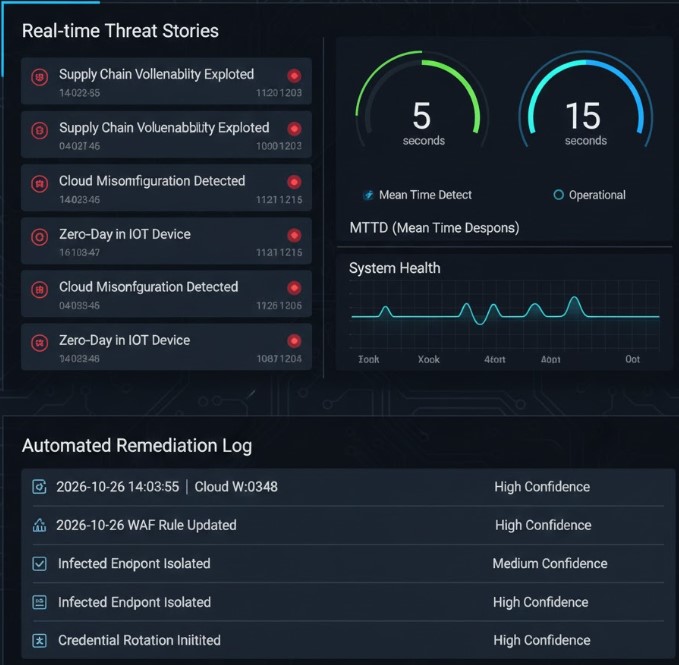
To maximize the ROI of cloud security, organizations must automate 100% of their routine triage tasks. An automated incident response cloud playbook should be ready for every common scenario, from ransomware containment to the revocation of compromised API keys. Speed is the only differentiator that matters. By reducing the Mean Time to Remediate from hours to minutes, enterprises can demonstrably reduce the financial impact of a breach. Continuous security validation, where AI-powered tools simulate real-world attacks 24/7, is now a mandatory practice to ensure that these automated responses actually work when a real threat materializes.
Best Practices and Production Recommendations for 2026
Successfully building an enterprise-ready SOC requires a balanced focus on the People, Process, and Technology (PPT) model. The most common mistake is over-investing in tools while neglecting the upskilling of analysts. In the cloud, your analysts need to be part data scientist and part detection engineer. Organizations should move toward a federated model of security ownership, where developers are empowered with pre-approved infrastructure-as-code templates that have security guardrails baked in. This “shift-left” strategy ensures that misconfigurations are caught in the CI/CD pipeline before they ever reach a production environment.
Another critical recommendation is to prioritize “smart data” over “big data.” Collecting every single log is a recipe for billing shock and analyst burnout. Instead, focus on high-fidelity telemetry that supports specific investigation flows. Maintain a single source of truth for all security findings to eliminate the “portal fatigue” that comes from jumping between twelve different dashboards. By practicing regular tabletop exercises and simulated “cyber war games,” your team can build the muscle memory needed to respond with precision during a high-stakes incident.
Strategic Outlook: Future-Proofing Cloud Security Operations
As we look toward 2026, the boundaries between the SOC and the business will continue to dissolve. Security is no longer a localized IT function; it is a board-level strategic imperative. The organizations that thrive will be those that embrace radical transparency and collaborative defense, sharing threat intelligence across the UK and US markets to stay one step ahead of a highly organized adversary. The road to a resilient, cloud-native SOC is a marathon, not a sprint, but the strategic advantages it provides in terms of risk reduction and operational agility are unparalleled.
Start your modernization journey today by conducting a thorough gap analysis against the NIST Cybersecurity Framework. Identify your most critical “protect surfaces,” centralize your identity governance, and begin the phased implementation of Zero Trust principles across your hybrid estate. By established these advanced operational frameworks now, you are not just defending your data; you are future-proofing your entire digital legacy.
Internal linking suggestions:
-
AWS Security: Link to your “Advanced AWS Landing Zone Security Guide.”
-
Azure Identity: Link to “The Senior Architect’s Guide to Microsoft Entra ID.”
-
GCP Data: Link to “Securing BigQuery and Vertex AI in GCP.”
-
DevSecOps: Link to “Integrating Security into CI/CD Pipelines: A Hands-on Guide.”
External authority links suggestions: