

Top Amazon Web Services (AWS) Trends Dominating 2026 in the US & UK
As we step into 2026, Amazon Web Services (AWS) continues to lead the global cloud infrastructure market and is evolving rapidly under new pressures: AI-first workloads, sustainability demands, FinOps maturity, hybrid-cloud strategies, and enterprise compliance.
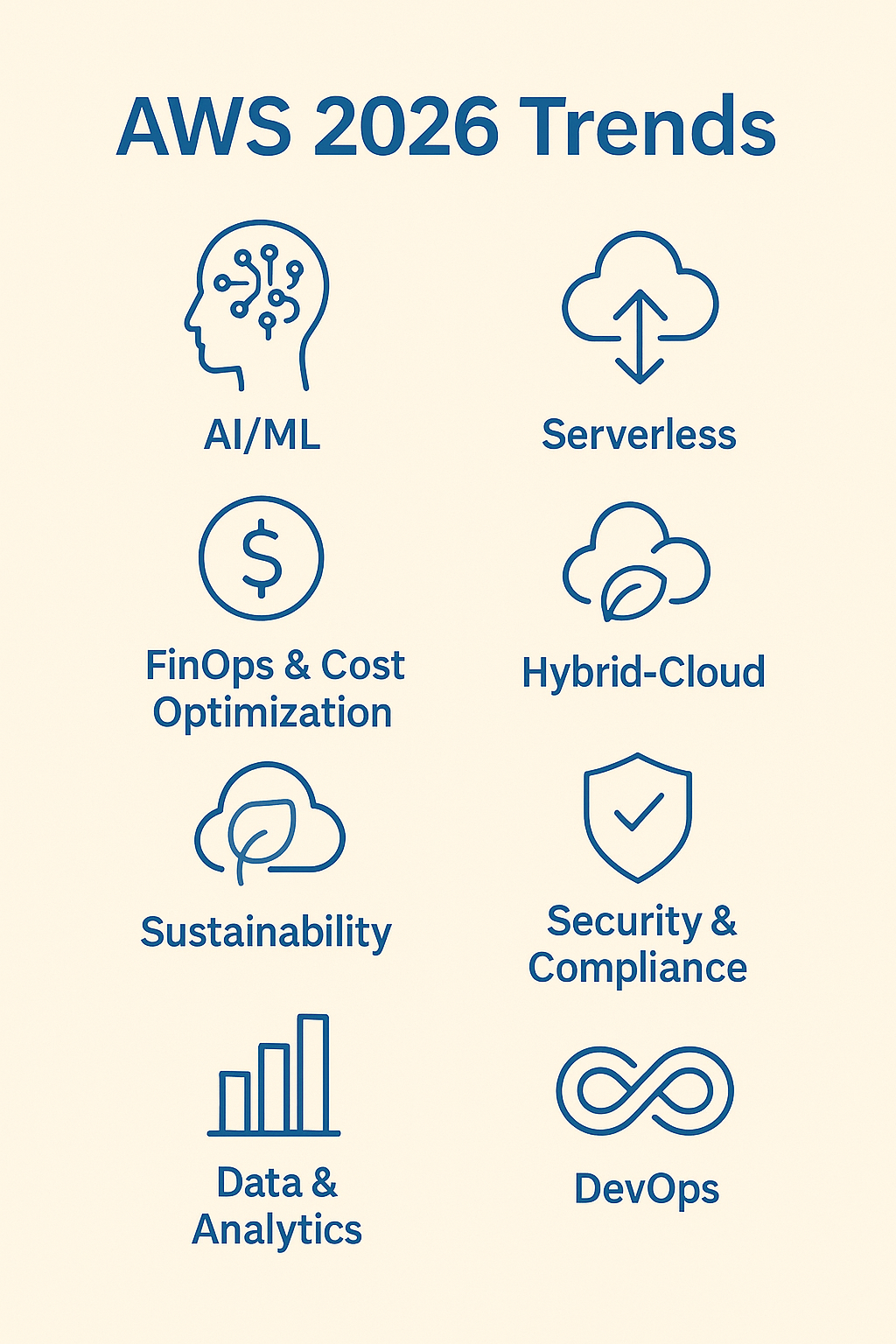
For businesses and cloud engineers in the US, UK, and globally, this means new opportunities and challenges. In this article, we highlight the top AWS trends that are set to dominate 2026 and explain how you can leverage them in your architectures, cost strategies, and cloud roadmap.
AI, ML & Generative Workloads Drive AWS Cloud Growth
AI On-Cloud Momentum
AI and generative workloads are now the core reason many companies move infrastructure to AWS rather than staying on-prem. According to recent forecasts, the shift of AI workloads to the cloud is accelerating sharply in 2026.
Services like Amazon Bedrock, SageMaker, and AWS GPU/ML infrastructure now support heavy ML training, inference, and generative models at scale making AWS the go-to for data-driven and AI-first companies.
New Hardware: Graviton5 & AI-Optimized Chips
At the 2025 re:Invent event, AWS unveiled AWS Graviton5, its newest high-performance, energy-efficient CPU generation, designed for workloads such as analytics, application servers, and database engines.
For 2026, expect a growing trend where cloud architects re-evaluate existing EC2 / compute fleets for cost/performance using Graviton5 a powerful lever for both performance and sustainability.
Serverless, Containers & Modern Cloud-Native Architectures Rising
Serverless Adoption Accelerates
Serverless adoption on AWS via AWS Lambda, event-driven services and microservices patterns continues to rise. This trend aligns with broader 2025 forecasts that highlight serverless (and container-based) architectures as central to cloud evolution.
For many startups and enterprises in the US & UK, serverless dramatically reduces overhead, accelerates deployment, and brings pay-as-you-go efficiency enabling them to scale without huge upfront infrastructure costs.
Containers and Kubernetes on AWS
Container orchestration on AWS via EKS and other container services remains popular as applications become more distributed and cloud-native.
In 2026, container + serverless hybrid architectures will likely dominate new application builds, especially for workloads needing portability, scalability, and microservices patterns.
FinOps, Cost Optimization & Sustainable Cloud Practices
Cloud Cost Optimization Gains Center Stage
With cloud consumption and AI workloads growing rapidly, cloud bills are poised to rise significantly in 2026. Analysts predict cost runaways if companies don’t adopt robust cost-management practices.
Enter FinOps (cloud cost governance) AWS customers in the US and UK are increasingly building workflows around monitoring, tagging, budgets, rightsizing, and cost visibility.
Why Top Amazon Web Services (AWS) Trends Dominating 2026 in the US & UK is because of Sustainability & Green Cloud Push

Sustainability is becoming more than ethical it’s becoming a business requirement, particularly in Europe. AWS’s investments in efficient chips (like Graviton5), and data centers optimized for energy efficiency, reflect a broader cloud trend toward greener infrastructure.
Expect “sustainable cloud architecture” to become a standard requirement for new AWS deployments by 2026.
Cloud Migration, Hybrid-Cloud & Multi-Cloud Strategies Surge
Post-Migration Maturity: Optimization & Innovation
The global cloud migration wave continues and 2025–2026 is increasingly about optimizing existing cloud workloads, not just migrating. Experts see a surge in hybrid-cloud and multi-cloud adoption as businesses aim for flexibility, resilience and regulatory compliance.
AWS remains the backbone for many traditional workloads, but companies now combine AWS with other clouds or on-prem systems for redundancy and data-sovereignty.
Hybrid & Multi-Cloud For Compliance & Resilience
Especially for UK / EU-based customers, hybrid or multi-cloud architectures allow compliance with data-residency laws while still using AWS for core workloads.
This trend makes multi-cloud strategy a key AWS-era discussion in 2026.
Enterprise-Grade Security, Compliance & Governance
Zero-Trust & Security-First Cloud Adoption
With increasing cyber threats and stricter regulations globally, AWS’s enterprise clients particularly in regulated sectors are adopting zero-trust architectures, rigorous identity/access management, and compliance frameworks.
2026 will likely see security & compliance become default not optional in all serious AWS deployments.
Enterprises Embrace AWS as Strategic Platform
According to a 2025 report, AWS continues to lead in ability to execute and completeness of vision among cloud providers, making it the preferred strategic partner for many enterprises.
Large organisations in the US & UK increasingly rely on AWS for mission-critical workloads, compliance, global deployment, and scalability.
Data, Analytics & Cloud-Native Data Platforms on AWS
Explosive Growth in Cloud Data & Analytics Workloads
As data grows exponentially, many organizations are migrating their analytics and data-warehousing workloads to AWS. Analysts expect cloud-based data storage and analytics to become the default by 2025–2026.
AWS’s data services storage, analytics, managed databases and ML integration make it a natural choice for “data-first” enterprises.
Integration of Data + AI + Cloud Infrastructure
The synergy between data, AI/ML and compute on AWS accelerates adoption even more. Companies deploying large-scale analytics, AI models, and real-time data processing pipelines look to AWS for end-to-end cloud-native data platforms.
DevOps, Infrastructure as Code & Cloud-Native Modernization
Infrastructure as Code & Agile Cloud Delivery
Modern cloud deployments increasingly use Infrastructure as Code (IaC), continuous integration/delivery (CI/CD), and DevOps practices to manage complexity, scalability and speed and AWS continues to provide strong support for these paradigms.
In 2026, expect DevOps + cloud native architecture to be the default approach for new AWS projects not the exception.
Observability, AIOps and Real-Time Monitoring
With growing complexity (AI, microservices, hybrid cloud), observability and AIOps tools become critical. The trend toward automated monitoring, cost-anomaly detection, and AI-driven ops will accelerate on AWS.
What This Means for US & UK Businesses in 2026
-
For startups and SMBs, serverless + Graviton5 + cost optimization + cloud-native patterns offer a cost-effective path to scale.
-
For enterprises, a mix of AWS + hybrid/multi-cloud + compliance + FinOps will define cloud strategy.
-
For data-driven businesses, AWS’s AI + data + analytics capabilities offer unmatched agility.
-
For regulatory / compliance-heavy sectors (finance, healthcare, public sector), AWS’s security, global coverage, and hybrid cloud options will remain highly attractive.
The upshot: in 2026, AWS isn’t just a cloud vendor it’s becoming the strategic backbone for digital transformation, AI, data, and global-scale infrastructure.
FAQ – Top Questions on AWS Trends 2026
Q1: Is AWS still the leading cloud provider in 2026?
Yes as of 2025, AWS holds around 29% of the global cloud infrastructure market share.
Q2: What makes Graviton5 important for 2026?
Graviton5 brings better CPU efficiency, performance per dollar, and energy-efficient compute ideal for analytics, AI workloads, and cost-sensitive applications.
Q3: Why is FinOps gaining importance now on AWS?
Cloud usage and AI workloads are rising fast, making uncontrolled spend a real risk. FinOps helps teams govern cloud costs, optimize resources, and enforce financial accountability.
Q4: Are serverless and containers replacing traditional VMs on AWS?
Increasingly so serverless and containers offer agility, lower overhead, and scalability, especially for new cloud-native applications.
Q5: How do security and compliance trends affect AWS adoption in UK/Europe?
With stricter data sovereignty and compliance regulations, hybrid-cloud or multi-cloud strategies with AWS as backbone combined with zero-trust and IAM best practices are becoming standard.
| Latest AWS announcements & 2025–2026 roadmap | “Top announcements of AWS re:Invent 2025” — official blog post summarizing major new AWS services and innovations. (Amazon Web Services, Inc.) |
| Generative AI / ML + Cloud trend on AWS | “AWS Cloud Trends 2025: How Business Leaders Can Stay Ahead” — a public write-up highlighting AI/ML, automation, cloud scalability on AWS. |
| Cost Optimization & FinOps importance on AWS | “AWS Cost Optimization: Strategies, Tools, and Best Practices for Maximizing Cloud ROI” — DataCamp guide covering cost-saving best practices on AWS. |
| Hybrid / Multi-Cloud & Migration wave toward 2025/2026 | “Why 2025 is the Inflection Point for AWS Cloud Migration” — AWS enterprise-strategy blog about accelerating cloud adoption and migration. (Amazon Web Services, Inc.) |
| Cloud computing market stats, adoption growth, demand drivers | “90+ Cloud Computing Statistics: A 2025 Market Snapshot” — covers adoption, cloud waste, hybrid-cloud & cloud-cost trends globally. |
| New hardware / compute improvements for AI & scalable workloads | Coverage of AWS’s 2025–2026 hardware roadmap including AI infrastructure enhancements from re:Invent and related news. (Amazon Web Services, Inc.) |
| Serverless & modern cloud-native architecture momentum on AWS | Industry-wide discussion of cloud-native and serverless adoption as core architecture patterns for 2025+ across AWS. (Amazon Web Services, Inc.) |
| Sustainability, efficient cloud infrastructure, green cloud initiatives | Reports and blog-posts highlighting AWS focus on infrastructure efficiency, energy management and sustainable cloud operations. |