
Zero Trust Architecture in Cloud
The transition to zero trust architecture in cloud: An engineering blueprint for 2026 security resilience
The final quarter of 2025 has redefined the threat landscape for global enterprises, as the transition to zero trust architecture in cloud has evolved from a progressive security objective to an absolute survival necessity. High-profile data breaches in December 2025, including the massive exfiltration of 201 million records from major entertainment platforms and the unauthorized access to customer data at global automotive manufacturers, have demonstrated the catastrophic failure of traditional perimeter-based defenses. These incidents were largely driven by the exploitation of stolen credentials and OAuth tokens, highlighting that once an attacker bypasses the external gateway, they often find a flat network where lateral movement is trivial. For senior cloud architects in the US and UK, the mandate this week is clear: the implicit trust model must be dismantled and replaced with a framework that prioritizes continuous verification for every user, device, and service attempt. This shift is fueling a market expansion that is projected to reach billions by the end of 2025, as organizations grapple with the complexities of securing highly distributed, multi-cloud environments where the traditional network edge no longer exists.
The urgency surrounding NIST 800-207 cloud implementation is not merely a theoretical exercise in compliance. It is a direct response to the rise of AI-powered ransomware and the increasing sophistication of nation-state actors targeting cloud-native infrastructure. As enterprises accelerate their digital transformation, they are finding that legacy VPNs create significant security blind spots and performance bottlenecks, leading the vast majority of new remote access deployments to favor zero trust network access ZTNA by late 2025. The primary business pain point remains the balance between stringent security and user experience; architects must deliver a secure remote and hybrid work environment that does not impede developer velocity or operational agility. In this climate, a robust zero trust architecture in cloud serves as the foundation for cyber resilience, ensuring that even if an initial foothold is established, the blast radius of the breach is strictly contained through identity-driven microsegmentation and real-time behavioral analytics.
Technical mechanics of the zero trust control and data planes
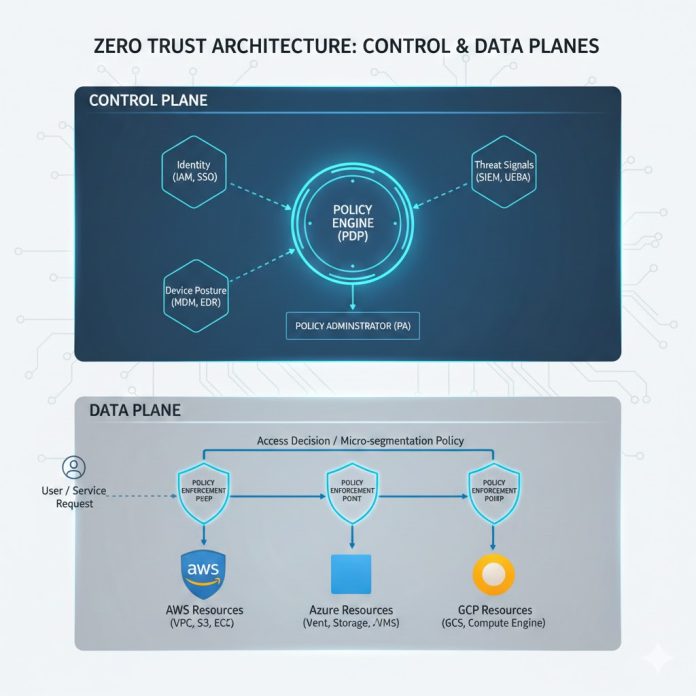
A sophisticated zero trust architecture in cloud operates on the foundational principle of “never trust, always verify,” which assumes that every request originates from an untrusted network regardless of its point of entry. The structural integrity of this model depends on a clear separation between the control plane and the data plane. The control plane acts as the strategic brain, encompassing the policy engine and policy administrator, while the data plane serves as the tactical enforcement layer where actual resource traffic flows. Every attempt to access a resource must be mediated by a policy enforcement point that queries the control plane for a decision based on real-time trust context. This context is derived from a multidimensional analysis of user identity, device posture, geographic location, time of day, and current threat intelligence.
The policy engine calculates a dynamic risk score for each request, often utilizing machine learning to compare the current activity against an established behavioral baseline. If a request from a senior engineer to access a production Kubernetes cluster occurs from an unrecognized device in a high-risk region, the system may calculate a high risk probability and automatically trigger a challenge. For instance, the trust evaluation can be modeled as a weighted function of security attributes:
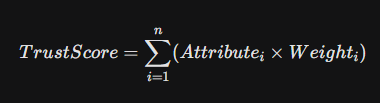
Where $Attribute_{i}$ represents variables like phishing-resistant MFA status, device encryption state, and patch level. Only when the $TrustScore$ exceeds a predefined threshold is the policy administrator permitted to signal the enforcement point to establish a temporary, encrypted session between the subject and the resource. This approach eliminates the persistent “on-ramps” to the network that traditional VPNs provide, instead creating a dynamic, session-based micro-perimeter around every individual asset.
| Architecture Component | Description | Cloud-Native Function |
| Policy Engine (PE) | The decision-making logic of the control plane. | Evaluates Cedar or OPA policies in real-time. |
| Policy Administrator (PA) | Executes the decisions made by the PE. | Generates temporary credentials or session tokens. |
| Policy Enforcement Point (PEP) | Intercepts and secures traffic to the resource. | Identity-Aware Proxy or Service Mesh Sidecar. |
| Trust Context | The aggregate signals used for evaluation. | Device health, IP reputation, and IAM attributes. |
| Resource | The target asset being protected. | S3 buckets, EC2 instances, or API endpoints. |
In a cloud-native flow, this architecture facilitates identity-aware proxy deployment, which serves as the gatekeeper for internal applications and APIs. When a user attempts to access an application hosted in a private subnet, the proxy intercepts the request before it reaches the target server. The proxy validates the user’s identity through a centralized identity provider—such as Microsoft Entra ID or Okta—and checks for a valid device certificate. This ensures that not only is the user authorized, but the device itself meets the organization’s security standards, such as having an active endpoint detection and response (EDR) agent and up-to-date operating system patches. This dual verification of identity and device health is critical for preventing breaches involving compromised personal laptops or unmanaged “shadow IT” assets.
Implementation patterns across major cloud service providers
The realization of zero trust architecture in cloud varies across the major providers, each offering unique tools that cater to different enterprise needs. Senior architects often find that choosing a platform depends heavily on their existing ecosystem, yet the core objective remains the same: transitioning from network-centric security to identity-first security. In late 2025, the consolidation of security service edge (SSE) and SASE platforms has accelerated, as vendors strive to offer unified consoles that manage security across disparate cloud and on-premises environments.
AWS Verified Access and the Cedar policy language
AWS has revolutionized the implementation of zero trust for its users through AWS Verified Access, a service that eliminates the need for legacy VPNs by providing secure, VPN-less access to internal applications. The internal working of Verified Access relies on the evaluation of trust data from identity and device providers against granular access policies defined in the Cedar policy language. Cedar is a purpose-built language for authorization that is both expressive and highly performant, allowing architects to define complex logic like “allow access if the user belongs to the finance group AND the device is corporate-owned AND the request originates from the US or UK”.
A key innovation in 2025 for AWS environments is the adoption of VPC Lattice, which extends zero trust principles to service-to-service communication. Lattice provides a centralized way to manage service discovery, traffic mirroring, and authentication across multiple VPCs and accounts without requiring complex network peering or transit gateways. By utilizing IAM for service-to-service authorization, AWS allows developers to build microservices where every API call is explicitly verified and logged, fulfilling the requirements for deep visibility and auditing. This setup is particularly effective for organizations looking to minimize their attack surface while scaling complex, event-driven architectures.
Microsoft Secure Future Initiative and the Azure framework
Microsoft’s commitment to zero trust is embodied in its Secure Future Initiative (SFI), which represents a massive engineering effort to modernize the security posture of all Microsoft products and services. For architects, the Azure zero trust framework is built upon the immense signal data generated by Microsoft Entra ID and Defender for Cloud, which process over 84 trillion security signals daily to inform conditional access decisions. The SFI emphasizes “secure by design” principles, where security is a core priority from the earliest phases of development, leading to automated remediation of vulnerabilities across the vast majority of Azure’s internal production infrastructure.
When considering how to implement zero trust in Azure environments, the focus is often on the integration of identity and endpoint data. Microsoft’s strategy encourages the use of phishing-resistant MFA cloud solutions, which are now used by nearly all of Microsoft’s internal productivity accounts to prevent session hijacking. Azure also provides robust tools for cloud-native microsegmentation, such as Azure Firewall and Network Security Perimeters, which allow for the isolation of production systems and the restriction of managed identity authentication to specific network locations. This holistic approach ensures that identity, network, and workload security are managed through a unified control plane, reducing the complexity of multi-cloud management.
Google Cloud BeyondCorp and Global VPC Security
Google Cloud Platform (GCP) continues to be a leader in the zero trust space with its BeyondCorp model, which has been the cornerstone of Google’s internal security for over a decade. The GCP implementation focuses on the Identity-Aware Proxy (IAP) to protect applications and virtual machines without requiring a VPN. One of the most significant advantages of the GCP architecture is its global VPC design, which provides uniform networking controls across all regions by default. This eliminates the need for inter-VPC transit gateways and simplifies the orchestration of access across a global footprint, a distinct contrast to the more regional architectures of AWS and Azure.
For enterprise customers, GCP VPC service controls best practices involve defining service perimeters that act as a virtual wall around sensitive data stored in services like BigQuery and Cloud Storage. These perimeters block unauthorized data exfiltration attempts even if an attacker has valid credentials, effectively mitigating the risk of stolen OAuth tokens that were prevalent in recent 2025 breaches. Furthermore, Google has integrated these capabilities into Chrome Enterprise Premium, turning the browser into a powerful endpoint security tool that enforces context-aware policies directly at the point of interaction. This is particularly valuable for securing agentic AI with zero trust architecture, as the browser can inspect inputs and outputs to prevent data poisoning or prompt injection in real-time.
| Feature | AWS Implementation | Azure Implementation | GCP Implementation |
| VPN-less Access | AWS Verified Access | Microsoft Entra ID Proxy | Identity-Aware Proxy (IAP) |
| Policy Language | Cedar (Simplified & Testable) | Conditional Access (Signal-based) | Common Expression Language (CEL) |
| Networking | VPC Lattice & Security Groups | Network Security Perimeter | Global VPC & Service Perimeters |
| Key Advantage | High modularity & Cedar logic | 84T signals & Entra integration | Global network & Browser-native ZT |
Security compliance and the ROI of zero trust architecture
In the modern regulatory landscape, zero trust architecture in cloud has become the primary mechanism for meeting stringent data protection standards such as SOC 2, ISO 27001, and HIPAA. For B2B SaaS organizations and enterprises in the US and UK, these certifications are no longer optional but are table stakes for securing deals and maintaining customer trust. The core principles of zero trust—continuous verification and least privilege—align perfectly with the requirements for robust identity management and auditability mandated by these frameworks.
Mapping zero trust to compliance frameworks
Implementing zero trust directly satisfies multiple controls within major compliance standards. For example, ISO 27001’s Annex A controls, which cover 93 security areas, are significantly bolstered by zero trust principles such as individual user identity verification and role-based access control with least privilege. In healthcare, zero trust compliance for healthcare cloud is essential for HIPAA adherence, specifically regarding the security of electronic protected health information (ePHI). By using phishing-resistant MFA and AES-256 encryption for data at rest and TLS 1.3 for data in transit, healthcare organizations can ensure that only authorized personnel can access sensitive patient records, thereby minimizing the risk of unauthorized disclosure.
Furthermore, the ROI of zero trust in enterprise cloud computing is evidenced by the reduction in breach incidents and audit costs. Research indicates that a well-implemented zero-trust security model can reduce breach incidents by as much as 60%, while automated compliance monitoring can cut audit costs by 50%. These savings are realized by replacing expensive, fragmented legacy security tools with unified, cloud-native platforms that provide better visibility and more efficient management of the entire security posture. For CFOs and CTOs, the transition to zero trust is not just a security upgrade; it is a strategic investment in operational efficiency and risk mitigation.
Encryption and the post-quantum future
A critical component of any zero trust architecture is the protection of data through advanced encryption techniques. In 2025, the focus has shifted toward ephemeral credentials management and the rollout of quantum-safe encryption standards. As quantum computing advances, traditional encryption algorithms are becoming vulnerable, leading cloud providers like AWS and Microsoft to integrate NIST-standardized post-quantum cryptography into their core services. Senior architects must now prioritize the migration of their most sensitive workloads to these quantum-resistant models to ensure long-term data sovereignty and security.
Continuous monitoring and logging form the third pillar of this triad, providing the evidence required for forensic analysis and compliance reporting. Tools such as AWS CloudTrail, Azure Monitor, and Google Cloud Flow Logs are essential for capturing every access attempt and connection state, allowing security teams to detect anomalies like unusual login patterns or high-volume data egress in real-time. By integrating these logs into AI-powered threat detection platforms, organizations can automate the response to potential threats, reducing the time between detection and remediation from hours to minutes.
Tools and platforms: A market analysis for 2026
The market for zero trust solutions is currently dominated by a few key players who have consolidated their offerings into powerful, cloud-native platforms. While the major cloud providers offer built-in tools that are highly integrated, many enterprises also look toward third-party leaders like Zscaler, Fortinet, and Check Point for cross-cloud capabilities and advanced SASE features. The choice between these options often involves a trade-off between the depth of integration with a specific cloud provider and the flexibility of a vendor-neutral platform.
Cloud-native tools vs. third-party SASE platforms
For organizations heavily invested in a single cloud ecosystem, the native tools like AWS Verified Access or GCP IAP are often the most cost-effective and easiest to deploy. However, for multi-cloud environments, a unified platform like Zscaler’s Zero Trust Exchange may offer a more consistent user experience and centralized management across AWS, Azure, and GCP. Zscaler has seen explosive growth by positioning itself as the baseline for secure remote access, with a significant portion of the Fortune 500 adopting its ZTNA solutions as a replacement for legacy VPNs.
| Platform | Core Strength | Ideal Use Case |
| Zscaler Exchange | Global cloud security fabric with ZTNA focus. | Large-scale multi-cloud enterprises. |
| Fortinet Unified SASE | High-performance networking with AI-powered security. | Branch-heavy retail and distributed networks. |
| Check Point Infinity | AI-first threat prevention across mesh environments. | Hybrid mesh environments and cloud workloads. |
| Cloud-Native (AWS/Azure/GCP) | Deep integration with specific cloud services. | Organizations primary focused on one cloud ecosystem. |
The Forrester Wave and Gartner Magic Quadrant reports for late 2025 highlight that the market is moving toward “unified SASE,” where networking and security are managed as a single entity. Vendors like Netskope and Palo Alto Networks are ranked highly for their ability to deliver these integrated capabilities across diverse customer use cases. When evaluating these tools, architects should prioritize those that offer real-time executive visibility and mobile-friendly dashboards, as C-suite mandates for cyber risk management are becoming increasingly common.
Automated validation and the rise of CNAPP
Another emerging trend in 2026 is the adoption of Cloud Native Application Protection Platforms (CNAPP), which unify CSPM, workload protection (CWPP), and entitlement management (CIEM) into a single solution. These platforms go beyond static misconfiguration checks to provide automated cloud security validation, simulating real-world attack scenarios to identify and mitigate vulnerabilities before they can be exploited. By connecting the dots between a vulnerable, internet-facing container and a misconfigured IAM role, CNAPPs allow security teams to prioritize the small percentage of alerts that represent real, exploitable risk.
Production best practices and implementation recommendations
Successfully deploying a zero trust architecture in cloud requires more than just technical configuration; it necessitates a cultural shift in how an organization approaches security. Senior architects must lead this transition by implementing a crawl-walk-run strategy that avoids massive disruption to existing business processes while steadily improving the security posture.
Strategic roadmap for zero trust adoption
-
Define the Protect Surface: Identify the most critical data, applications, and assets that require immediate protection. This involves conducting a thorough assessment of data flows and infrastructure dependencies to create a comprehensive inventory of all assets.
-
Establish Strong Identity and Access Management: Centralize IAM across all environments and mandate the use of phishing-resistant MFA for every user account. Implement least privilege access relentlessly, ensuring that users have only the minimum permissions required for their specific tasks.
-
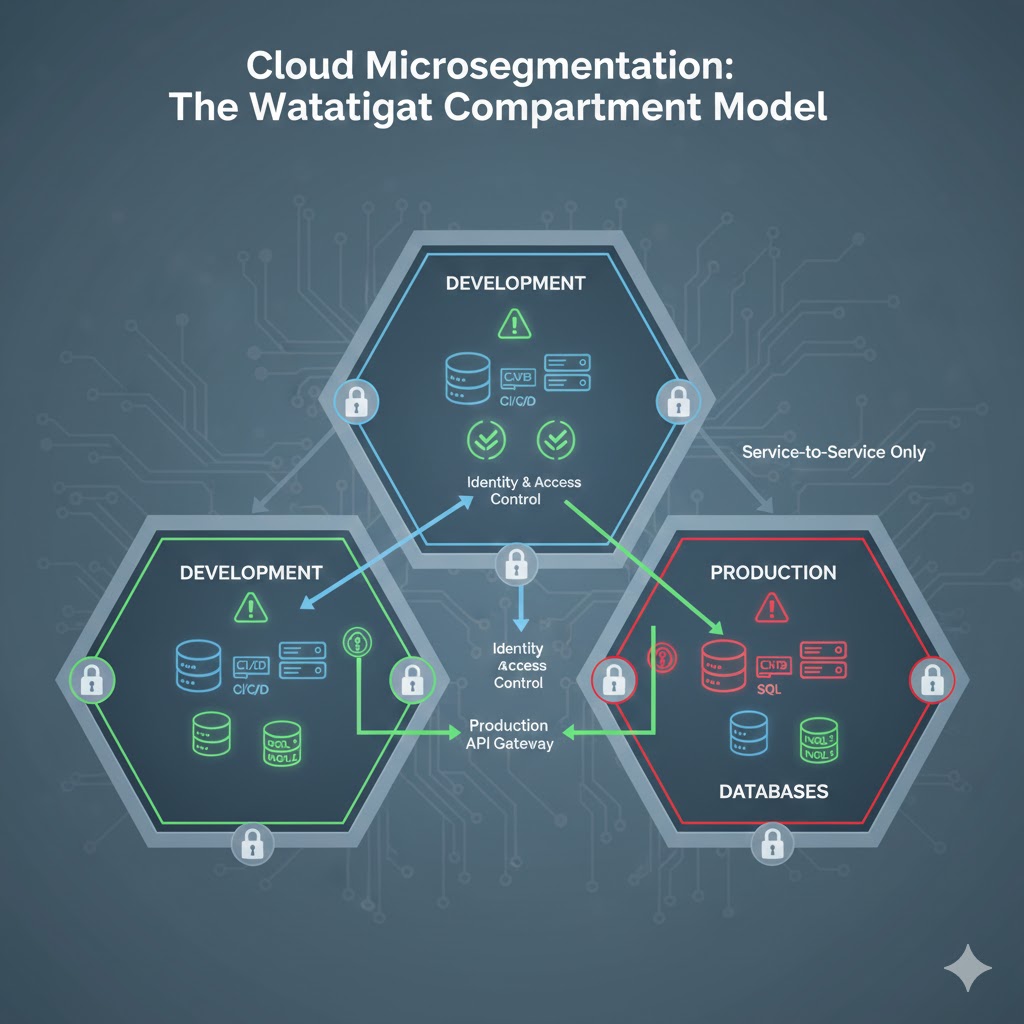
Implement Microsegmentation: Divide the network into small, isolated segments using cloud-native security groups and virtual private clouds. This “watertight compartment” model prevents lateral movement and contains breaches within a limited blast radius.
-
Leverage Automation and AI: Use CSPM and CNAPP tools to automate the discovery of assets and the detection of misconfigurations. Incorporate AI-driven behavioral analysis to identify and respond to threats in real-time, reducing the reliance on manual intervention and minimizing the time between detection and response.
-
Continuous Monitoring and Validation: Establish a culture of “assume breach” by continuously monitoring all network activity and regularly conducting penetration tests and vulnerability scans. Use session recording and detailed logging to maintain an audit trail for forensic analysis and compliance reporting.
Common pitfalls to avoid
One of the most frequent mistakes is neglecting legacy systems that may not natively support modern identity protocols. In these cases, architects should look toward identity orchestration tools that can bridge the gap between cloud-native and on-premises environments without requiring extensive code rewrites. Another common error is underestimating the complexity of policy management, which can lead to “policy sprawl” and conflicting rules. Utilizing AI-powered policy management can help streamline this process by automatically adjusting privileges and eliminating redundant or outdated rules.
Finally, failing to prioritize the developer experience can lead to resistance and the bypassing of security controls. Security should be integrated into the CI/CD pipeline through DevSecOps practices, making it a frictionless part of the development lifecycle rather than a final roadblock. By shifting security left in the development lifecycle and providing developers with pre-approved IaC templates and automated scanning tools, organizations can improve release velocity while maintaining a robust security posture.
The future of zero trust and securing agentic AI
As we move into 2026, the boundaries of zero trust architecture in cloud are being extended to secure the next wave of technological innovation: agentic AI systems. These autonomous agents, built on large language models, present unique security challenges, including the risk of prompt injection, model poisoning, and unauthorized data leakage. Securing these systems requires a zero-trust approach where every interaction between a user, an AI agent, and a sensitive database is explicitly verified and authorized.
Implementing deep inspection of inputs and outputs is critical for detecting adversarial examples designed to manipulate AI behavior. Architects should deploy AI-specific WAF rules and utilize services like Amazon Bedrock or Vertex AI with VPC service controls to ensure that AI workloads are isolated and monitored. By applying the “never trust, always verify” principle to AI agents, organizations can harness the efficiency gains of artificial intelligence without exposing themselves to new and unpredictable risks.
Conclusion: Finalizing the 2026 security posture
The pivot toward zero trust architecture in cloud is no longer a choice but a mandatory evolution for any organization operating in the modern digital landscape. The failures of the old-school castle-and-moat model are documented in the headlines of 2025, and the tools to build a more resilient future are now mature and battle-tested. By prioritizing identity, embracing microsegmentation, and leveraging the power of AI-driven automation, senior architects can create a security posture that is not only robust against current threats but is also future-proofed against the emerging challenges of the quantum and AI eras. The journey to zero trust is continuous, but the strategic advantages it provides in terms of risk reduction, compliance, and operational agility make it the most critical initiative for 2026 and beyond.
Internal linking suggestions:
-
AWS Focus: Guide to Cedar Policy Language for Verified Access; Integrating VPC Lattice for Service-to-Service Security.
-
Azure Focus: Implementing Microsoft Entra ID for Phishing-Resistant MFA; The Role of Defender for Cloud in Azure Zero Trust.
-
GCP Focus: Managing VPC Service Perimeters for Data Exfiltration Prevention; BeyondCorp Enterprise vs. Chrome Enterprise Premium.
External authority links suggestions: