
Centralized Logging Architecture Multi Cloud Mastering
The 2026 Engineering Blueprint
The digital landscape of late 2026 has been defined by a relentless surge in sophisticated, cross-tenant cyberattacks, placing immense pressure on enterprise architects to rethink their visibility strategies. High-profile data breaches reported this week in the US and UK, involving massive exfiltrations from cloud-native platforms and the compromise of millions of records, have underscored a harsh reality: the traditional, siloed approach to observability is failing. Organizations are no longer just asking how to store data; they are struggling to correlate telemetry across fragmented environments before the breakout time occurs. This urgency is driving a massive spike in search intent for a robust architecture multi cloud as teams attempt to close the gaps left by a 75% increase in cloud-wide intrusions over the last year.
The primary business pain point involves the “data deluge” vs. “mean time to respond.” For a senior cloud engineer, the challenge is not just the volume of logs from AWS, Azure, and GCP, but the cost-prohibitive nature of moving that data across provider boundaries. Egress fees are quietly dictating security decisions, often leading to dangerous blind spots where logs are stored locally but never analyzed globally. To achieve true cyber resilience, architects are pivoting toward a unified telemetry architecture that prioritizes ingestion-time enrichment and normalized schemas. This strategy ensures that an unauthorized API call in a London-based GCP project is immediately contextually linked to a suspicious login in a New York-based Azure tenant, providing the single-pane-of-glass visibility required for modern threat hunting.
Technical Mechanics of Distributed Telemetry Ingestion
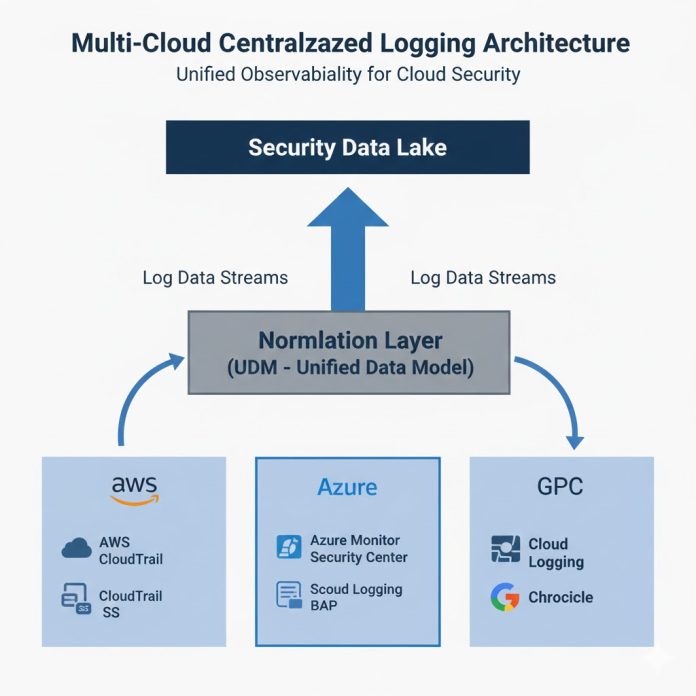
A high-performance centralized logging architecture multi cloud operates on the foundational principle of “decoupled collection and centralized analysis.” The structural integrity of this model depends on a clear separation between the collection tier, the processing pipeline, and the security data lake. In a mature cloud-native flow, logs are retrieved from diverse sources including AWS CloudTrail, Azure Activity Logs, and GCP Audit Logs through a combination of lightweight forwarders and direct ingestion APIs. The technical goal is to minimize the performance overhead on production workloads by utilizing eBPF-powered sensors for runtime visibility.
The internal working of the pipeline begins with data normalization. DISCO and other industry leaders have highlighted that unparsed logs are merely noise; therefore, adopting a model like the Advanced Security Information Model or a Unified Data Model is critical. This process ensures that disparate event schemas are mapped into a consistent structure at the point of ingestion. Once normalized, the logs undergo ingestion-time enrichment, where metadata such as user roles, asset sensitivity tags, and IP geolocation are appended. This contextual awareness allows the detection engine to distinguish between a routine administrative task and a high-risk anomalous access attempt by calculating a real-time risk score.
| Design Pattern | Connectivity Model | Primary Advantage | Latency Impact |
| Hub-and-Spoke | Transit Gateway / ExpressRoute | Centralized governance and inspection | Moderate (+10-20ms) |
| Cybersecurity Mesh | Peer-to-peer / Service Mesh | Localized enforcement and lower egress | Minimal (<5ms) |
| Mirrored Architecture | Regional Replication | High availability and DR readiness | Variable (Sync/Async) |
| Federated Aggregation | API-driven selective pull | Lowest cost for low-frequency audits | High (On-demand) |
The architectural choice often involves a trade-off between the depth of integration and the flexibility of a vendor-neutral platform. For organizations heavily invested in a multi-cloud strategy, the hub-and-spoke network pattern remains the gold standard for centralized management. By routing all telemetry through a secure transit zone, architects can enforce consistent security policies and conduct deep packet inspection before logs reach the persistent storage layer.
Real-World Implementation Across Hyperscalers
The realization of a architecture multi cloud varies significantly across the primary providers, requiring engineers to be fluent in three “identity languages” simultaneously. In 2026, the consolidation of security platforms has accelerated, as vendors push for natively integrated capabilities from code to cloud to SOC.
Amazon Web Services: Decentralized Nodes with Central Guardrails
AWS architectures in 2026 are measured by verifiable governance. The standard engineering pattern involves using AWS Organizations to enforce Service Control Policies that mandate CloudTrail and GuardDuty activation across all accounts. A critical use case for global retail giants involves using serverless Lambda functions to aggregate logs into a central S3-based security data lake. By utilizing AWS KMS for automated key rotation and customer-managed keys, organizations maintain data sovereignty while enabling cross-account forensics.
Microsoft Azure: Identity-Centric Aggregation
Azure remains the dominant choice for enterprises deeply integrated into the Microsoft 365 ecosystem. The core of its logging strategy anchors on Microsoft Sentinel and Microsoft Entra ID. In UK-based financial services, we frequently see the implementation of conditional access policies informed by real-time risk signals from the analytics tier. Azure’s commitment tiers allow for predictable scaling, enabling teams to ingest high-volume network logs from Azure Firewall without the billing shock associated with traditional per-gigabyte models.
Google Cloud Platform: AI-Native Scale and Chronicle
GCP distinguishes itself through its AI-powered innovation and the massive data processing capabilities of Google Security Operations. The GCP implementation focuses on the Identity-Aware Proxy to protect resources without a VPN. A major trend for technology firms is the integration of Mandiant threat intelligence directly into the Chronicle SIEM, allowing for retro-hunts where a year of historical logs can be scanned in seconds for newly discovered indicators of compromise.
| Service Category | AWS Native Stack | Azure Native Stack | GCP Native Stack |
| Management Log | CloudTrail | Activity Logs | Cloud Audit Logs |
| Workload Telemetry | CloudWatch Logs | Azure Monitor Logs | Cloud Logging |
| Threat Detection | GuardDuty | Defender for Cloud | Security Command Center |
| Centralized SIEM | Security Hub | Microsoft Sentinel | Google SecOps (Chronicle) |
Tools and Platforms Comparison: Selecting the Engine
The market for multi-cloud logging solutions is currently dominated by a mix of cloud-native suites and third-party observability leaders. Deciding which platform to use depends on your organization’s maturity level and the complexity of your multi-cloud footprint. For many enterprises, the decision between an in-house build and a managed service depends on the availability of specialized talent, as the skills gap remains a significant barrier to 24/7 physical security operations.
Third-party tools like Datadog, Splunk, and ELK Stack provide the flexibility of a vendor-neutral layer that abstracts the complexity of individual cloud providers. Splunk excels in data transformation and deep indexing, making it ideal for time-sensitive forensic investigations across exabyte-scale datasets. Conversely, Datadog offers an in-context log explorer that allows analysts to pivot directly from metrics to related logs within a single interface, significantly improving the analyst experience and reducing alert fatigue.
| Platform | Core Strength | Ideal Use Case | Weakness |
| Splunk Enterprise | Deep SPL and indexing scale | Large-scale forensic investigations | High cost at extreme volume |
| Datadog | Unified observability / APM | Fast-scaling cloud-native startups | Complex cardinality management |
| Elastic (ELK) | Open-source flexibility | Custom-built internal dashboards | High resource/compute overhead |
| OpenObserve | 140x data compression | High-volume log retention / Low TCO | Newer ecosystem/fewer plugins |
| Wiz Defend | Agentless graph visibility | Identifying “Toxic Combinations” | Limited remediation in IDEs |
Emerging in 2026 is the rise of Cloud Native Application Protection Platforms that unify posture management and workload protection. These platforms go beyond static misconfiguration checks to provide automated cloud security validation, simulating real-world attack scenarios to identify vulnerabilities before they are exploited.
Security, Compliance, and the Cost of Inaction
Centralized logging architecture multi cloud is the primary mechanism for meeting stringent data protection standards such as SOC2 Type II, ISO 27001, and HIPAA. For B2B SaaS organizations, these certifications are no longer optional but are table stakes for securing enterprise deals and maintaining customer trust. The core principles of Zero Trust continuous verification and least privilege align perfectly with the requirements for robust identity management and auditability mandated by these frameworks.
Encryption and Post-Quantum Readiness
Data protection is foundational to both security and compliance. Industry best practices in 2026 mandate AES-256 encryption for data at rest and TLS 1.3 for all data in transit. Furthermore, forward-thinking enterprises are beginning to implement post-quantum encryption techniques to future-proof their defences against the “harvest now, decrypt later” strategy employed by nation-state actors. Protecting encryption keys via Hardware Security Modules ensures that even in a multi-tenant environment, the customer retains exclusive control over their data.
Cost Optimization and Egress Management
Storing logs locally is cheap; moving them is expensive. Multi-cloud log aggregation egress cost optimization is a critical pillar of any successful architecture. Every step your data moves outside its home region costs cash. Architects must group compute and data in the same availability zones and utilize private links or VPC endpoints to minimize the transfer tax. Implementing a tiered storage strategy where hot logs for real-time triage are kept in expensive analytics tiers and cold logs for compliance are offloaded to archival storage like AWS S3 Glacier can reduce infrastructure costs by as much as 40-60%.
| Storage Tier | Access Frequency | Retention Policy | Cost Impact (Simulated) |
| Analytics (Hot) | Real-time / Constant | 7-15 Days | Baseline (100%) |
| Searchable (Warm) | Weekly / Daily | 30-90 Days | 50% Reduction |
| Archival (Cold) | Monthly / Yearly | 1-7 Years | 90% Reduction |
| Compliance (Deep) | On-demand / Legal | 7-10 Years | 95% Reduction |
Best Practices and Production Recommendations
Successfully deploying a centralized logging architecture multi cloud requires a cultural shift toward a resilience-first mindset. Senior architects must lead this transition by implementing a Strategic roadmap that avoids tool sprawl and prioritizes smart data over big data.
-
Establish a Cloud Center of Excellence: Create a cross-functional team with executive sponsorship to set organization-wide standards for monitoring, tagging, and logging.
-
Implement Infrastructure as Code: Use Terraform or CloudFormation to version-control your logging pipelines and IAM roles. This prevents configuration drift and ensures that misconfigurations are caught in the CI/CD pipeline before release.
-
Automate Response with SOAR: Security teams should not be clicking through the same remediation steps manually. Develop automated incident response cloud playbooks that can isolate a compromised container or rotate a secret the moment a threat is validated.
-
Prioritize Machine Identity Governance: In 2026, machine identities vastly outnumber human accounts and are often overprivileged. Implement inventories of non-human actors and baseline their behavior to detect anomalies in API activity.
-
Continuous Security Validation: Static audits only provide a snapshot. Use AI-driven tools to simulate real-world attacks 24/7, validating that your logging architecture actually captures the signals needed for an investigation.
One of the most common mistakes is neglecting legacy systems that do not natively support modern identity protocols. Architects should use identity orchestration tools to bridge the gap between cloud-native and on-premises environments without requiring expensive code rewrites. Furthermore, failing to focus on the developer experience can lead to resistance; security must be a frictionless part of the development lifecycle, providing teams with pre-approved, “secure by design” templates.
| Practice | Level 1: Foundational | Level 3: Adaptive (Target) | ROI Multiplier |
| Identity | Standard MFA | Phishing-resistant MFA (FIDO2) | 10x Risk Reduction |
| Monitoring | Reactive Alerts | AI Behavioral Baselining | 75% Faster MTTR |
| Architecture | Perimeter-Based | Zero Trust / Microsegmentation | 60% Fewer Breaches |
| Compliance | Manual Audits | Automated Compliance as Code | 50% Lower Audit Cost |
| Automation | Manual Triage | Agentic SOC (Human-on-the-loop) | 40% Productivity Gain |
Conclusion: The Path to Autonomic Security Operations
The pivot toward a centralized logging architecture multi cloud is no longer a discretionary technical upgrade; it is a mandatory evolution for surviving in the 2026 threat landscape. The failures of the old “castle and moat” model are documented in the headlines of 2026, and the tools to build a more resilient future are now mature and battle-tested. By prioritizing identity as the new perimeter, embracing the power of AI-driven automation, and relentlessly optimizing for data quality over sheer volume, senior architects can create a security posture that is robust against current threats and future-proofed against emerging challenges.
Start your transition today by mapping your application dependencies and identifying your most critical protect surfaces. The journey to a fully integrated multi-cloud observability framework is continuous, but the strategic advantages it provides in terms of risk reduction, operational agility, and compliance readiness make it the most critical initiative for the year ahead. Embodying a “never trust, always verify” mindset across every layer of your telemetry pipeline will ensure that your organization doesn’t just survive an attack, but thrives in the aftermath.
Google Cloud (Chronicle / SecOps)
-
Overview of the Unified Data Model (UDM): Understand how Google SecOps standardizes data.
-
Ingesting AWS CloudTrail into Chronicle: Step-by-step guide to pulling AWS logs into GCP.
-
UDM Field List Reference: A technical map of all available normalized fields.
Amazon Web Services (Security Lake)
-
Amazon Security Lake User Guide: How to centralize security data using OCSF.
-
Collecting Custom Sources: Best practices for bringing non-AWS logs (Azure/GCP) into the AWS ecosystem.
Industry Best Practices
-
Multi-Cloud Security Architecture (GitGuardian): A deep dive into the challenges of identity and monitoring across clouds.
-
Log Monitoring for Cloud-Native (New Relic): Best practices for observability and alerting in distributed environments.