
Cloud Security Governance Framework
The shift to cloud-native architectures has fundamentally decoupled the perimeter from the data center. In today’s distributed enterprise, a single misconfigured S3 bucket or an over-privileged service account in a Kubernetes cluster can lead to a catastrophic data breach. As organizations in the US and UK scale their digital footprints, the need for a robust cloud security governance framework has shifted from a compliance checkbox to a core business enabler. Without a centralized authority and automated policy enforcement, the speed of DevOps becomes the greatest liability to the Chief Information Security Officer (CISO).
Effective cloud security governance is not about slowing down deployment; it is about providing the guardrails that allow engineering teams to move fast without veering off the cliff of non-compliance. From the perspective of a Cloud Architect, this requires a transition from manual oversight to Policy-as-Code (PaC) and continuous monitoring. This guide explores how to build a production-ready governance model that bridges the gap between technical agility and enterprise-grade security.
Engineering a Modern Cloud Governance Architecture
A modern governance framework is built on the principle of centralized visibility and decentralized enforcement. The architecture must account for the ephemeral nature of cloud resources, where workloads may exist for only minutes. At the heart of this system is the Cloud Management Layer, which integrates directly with the provider’s APIs to enforce organizational standards before resources are even provisioned.
The internal working of such a framework relies on a feedback loop of four critical components: Identity, Policy, Monitoring, and Remediation. When a developer attempts to deploy a resource via Terraform or AWS CloudFormation, the governance engine checks the template against predefined security policies. If the resource lacks encryption or has an overly permissive security group, the deployment is blocked at the CI/CD gate. This “Shift Left” approach ensures that security is baked into the infrastructure lifecycle rather than being an afterthought.
Core Architecture Components
-
Policy Engine: Tools like Open Policy Agent (OPA) or native services like Azure Policy allow architects to define what “secure” looks like in code.
-
Identity Boundary: This forms the new perimeter, utilizing Zero Trust principles to ensure that every request is authenticated and authorized based on real-time context.
-
Security Data Lake: Centralized logging of CloudTrail, Flow Logs, and Audit Logs into a unified repository for AI-driven threat detection.
Multi-Cloud Enterprise Use Cases
Navigating the nuances of AWS, Azure, and GCP requires a framework that respects the native capabilities of each provider while maintaining a unified security posture. Large enterprises rarely sit in a single cloud; they leverage a hybrid strategy to avoid vendor lock-in and optimize costs.
AWS Perspective: Scaling with Organizations and SCPs
In a large AWS environment, governance starts with AWS Organizations. Service Control Policies (SCPs) act as the ultimate guardrail, allowing architects to restrict entire regions or services regardless of the IAM permissions granted to individual users. For example, an organization might use an SCP to prevent any account in the production OU from disabling GuardDuty or CloudTrail. This ensures that even a compromised administrator account cannot “blind” the security team.
Azure Perspective: Management Groups and Blueprints
Azure excels in hierarchical governance. By utilizing Management Groups, enterprises can apply Azure Policies across hundreds of subscriptions simultaneously. A common use case involves enforcing “Allowed Locations” to ensure data sovereignty for UK-based customers, preventing data from leaving the UK South or UK West regions. Azure Blueprints further simplify this by packaging resource groups, policies, and ARM templates into a repeatable, compliant environment.
GCP Perspective: Hierarchical Resource Manager
Google Cloud’s resource hierarchy (Organization > Folders > Projects) is inherently built for governance. Organizations often use “Organization Policy Service” to restrict which APIs can be enabled or to enforce the use of specific VPC Service Controls. This is particularly effective for high-security environments where data exfiltration risks must be mitigated by creating a virtual perimeter around sensitive GCP resources like BigQuery or Cloud Storage.
Technical Platform and Tooling Comparison
Choosing the right toolset depends on whether your organization prioritizes native integration or multi-cloud abstraction. While native tools offer the deepest integration, third-party Cloud Security Posture Management (CSPM) platforms provide a “single pane of glass” view.
Cloud Governance Tooling Matrix
| Feature | AWS Control Tower | Azure Policy | GCP Org Policy | Wiz / Palo Alto Prisma |
| Primary Focus | Multi-account setup | Resource compliance | Hierarchical constraints | Multi-cloud CSPM |
| Enforcement | Proactive & Reactive | Real-time & Audit | Proactive (API) | Reactive / Auto-remediation |
| Complexity | High (setup intensive) | Medium | Low | Medium |
| Best For | Massive AWS footprints | Microsoft-centric shops | Cloud-native projects | Heterogeneous clouds |
| UK/US Compliance | Excellent (Config/Audit) | Built-in Blueprints | Highly granular | Cross-framework mapping |
Security, Compliance, and Risk Management
The goal of a governance framework is to mitigate risk while satisfying regulatory requirements like SOC2, ISO 27001, and PCI DSS. This is achieved through the implementation of technical controls that map directly to compliance mandates.
Identity and Access Management (IAM)
The primary risk in cloud environments is credential theft. Governance frameworks must mandate the use of Multi-Factor Authentication (MFA) and Identity Federation. Non-human identities (service accounts and machine identities) represent a growing attack surface. Implementing “Just-In-Time” (JIT) access ensures that developers only have elevated permissions for the duration of a specific task, reducing the window of opportunity for an attacker.
Encryption and Data Protection
Encryption must be the default state, not an option. Frameworks should enforce Server-Side Encryption (SSE) with Customer Master Keys (CMKs) stored in a Hardware Security Module (HSM). For UK organizations dealing with GDPR, the governance framework must also dictate data residency rules, ensuring that personally identifiable information (PII) never leaves the specified geographic boundary.
Continuous Compliance Table
| Framework | Core Requirement | Technical Control in Cloud |
| SOC2 | Access Control | Enforce MFA and RBAC across all consoles |
| ISO 27001 | Asset Management | Automated tagging and resource discovery |
| PCI DSS | Network Security | Micro-segmentation and egress filtering |
| GDPR | Data Sovereignty | Regional resource locking (Policy-as-Code) |
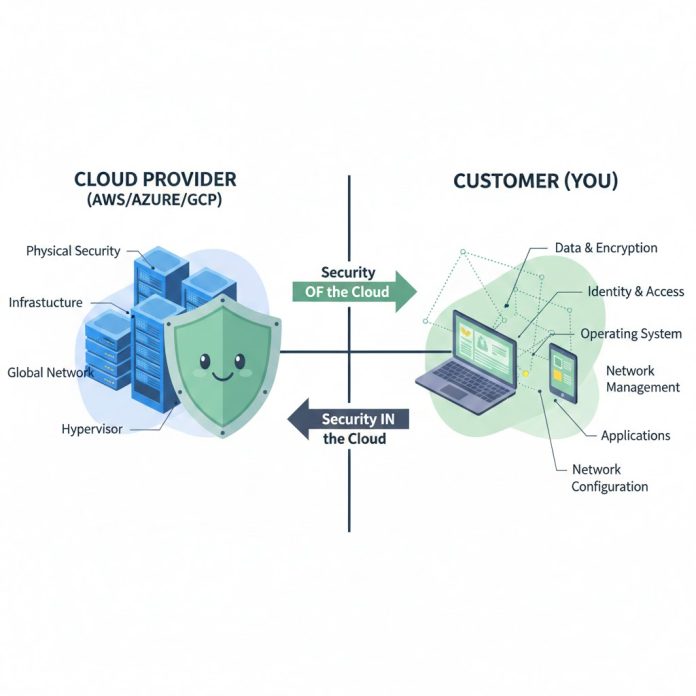
[Image representing the shared responsibility model between a cloud provider and a customer]
Best Practices for Enterprise-Grade Production
Transitioning from a theoretical framework to a production-grade implementation requires a phased approach. Avoid the “Big Bang” implementation that breaks existing developer workflows.
-
Automate Tagging for Cost and Security: Every resource must have tags for Owner, Environment, and Data Sensitivity. This allows for automated billing chargebacks and targeted security scanning.
-
Establish a Cloud Center of Excellence (CCoE): Governance is as much about culture as it is about technology. A CCoE brings together stakeholders from security, finance, and engineering to define policies that are actually workable in the real world.
-
Implement Automated Remediation: For high-risk violations—such as an S3 bucket becoming public—the governance engine should not just alert; it should automatically revert the change. This reduces the Mean Time to Remediate (MTTR) from hours to seconds.
Common Pitfalls to Avoid
-
Over-permissioning: Starting with ‘AdministratorAccess’ for developers “just to get things working.”
-
Shadow IT: Rigid governance that drives developers to use personal accounts for testing.
-
Log Exhaustion: Collecting every log without an automated way to filter for actionable signals.
Strategic Outlook and Conclusion
The future of cloud security governance is increasingly autonomous. As we move through 2025, we are seeing a shift toward AI-augmented governance, where machine learning models predict potential misconfigurations before they occur based on historical deployment patterns. Organizations that embrace a code-driven, transparent governance framework will find themselves better positioned to adopt new technologies—like generative AI and serverless—without compromising their security posture.
A well-architected cloud security governance framework is the foundation of digital trust. By aligning technical controls with business goals, enterprises can ensure that their journey to the cloud is both innovative and secure.
Internal Linking Suggestions
-
AWS Related: Implementation guide for AWS Service Control Policies (SCPs) in multi-account environments.
-
Azure Related: How to leverage Azure Management Groups for regional data residency compliance.
-
GCP Related: Best practices for VPC Service Controls and Google Cloud Organization Policies.
External Authority Links
-
AWS Security Documentation: https://docs.aws.amazon.com/security/
-
Azure Governance Documentation: https://learn.microsoft.com/en-us/azure/governance/
-
Google Cloud Security Foundations: https://cloud.google.com/security/docs/foundations-guide
-
NIST Cloud Computing Standards: https://www.nist.gov/programs-projects/cloud-computing