
Platform as a Service (PaaS)
Platform as a Service (PaaS) is a cloud computing model that provides a comprehensive environment for developers to build, test, deploy, and manage applications. By offering pre-configured tools, runtime environments, and infrastructure, PaaS simplifies the software development lifecycle and allows developers to focus solely on coding and innovation.
This guide delves deep into PaaS, its components, advantages, disadvantages, and leading providers, making it an essential read for anyone interested in leveraging PaaS for their business or projects.
What is Platform as a Service (PaaS)?
PaaS provides a cloud-based platform that includes the infrastructure (servers, storage, and networking) and tools (middleware, databases, and development frameworks) necessary for application development. Developers can access these services over the internet on a pay-as-you-go basis, removing the need to invest in or manage underlying hardware.
PaaS manages backend scalability, infrastructure, and maintenance, allowing developers to focus entirely on creating and deploying applications.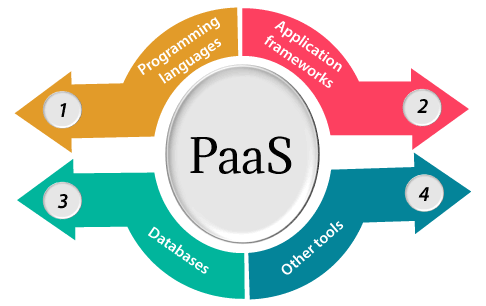
Key Features of PaaS
- Runtime Environment: Pre-configured environments support application execution without manual setup.
- Development Tools: Includes IDEs, version control systems, and debugging tools.
- Middleware: Simplifies connectivity between applications and databases.
- Database Services: Offers both relational and NoSQL database support.
- Scalability: Automatically scales resources based on traffic and usage.
- Collaboration Features: Team members can collaborate seamlessly using shared tools and repositories.
- Security Features: Integrated access control, encryption, and authentication tools.
- Monitoring and Analytics: Real-time tools track application performance and user behavior.
Read more about PaaS capabilities.
How PaaS Works
PaaS platforms provide an all-encompassing ecosystem that supports the entire application lifecycle. Developers upload their code, and the platform takes care of infrastructure management, resource allocation, and deployment. Common PaaS workflows include:
- Code Upload: Developers upload code to the PaaS platform.
- Build Process: The platform compiles and builds the application.
- Deployment: The application is deployed on virtual servers managed by the PaaS provider.
- Scaling: The platform automatically adjusts resources to meet traffic demands.
- Monitoring: Developers use tools to analyze application performance and debug issues.
Explore the PaaS architecture.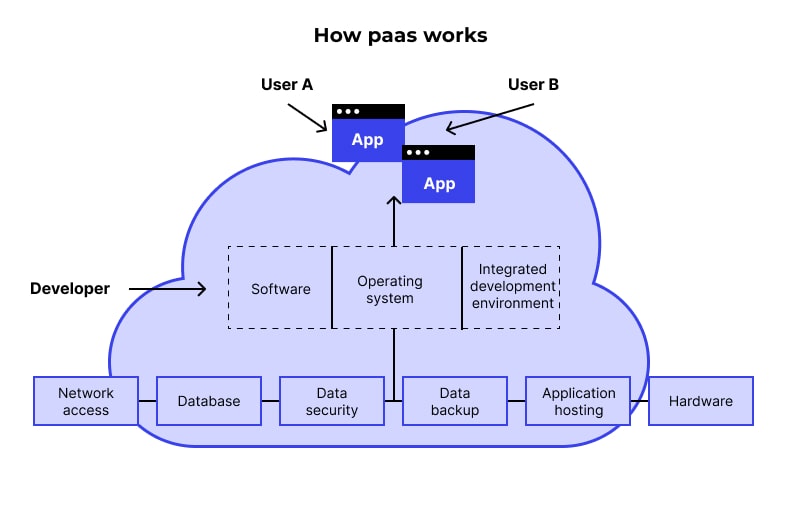
Services Provided by PaaS
1. Programming Languages
PaaS supports various programming languages, allowing developers to choose their preferred tools for application development. Supported languages typically include:
- Java
- Python
- Ruby
- .NET
- PHP
- Node.js
2. Application Frameworks
Frameworks provided by PaaS platforms simplify development by offering libraries, APIs, and tools for scalable applications. Examples:
- Django (Python)
- Ruby on Rails (Ruby)
- Spring Framework (Java)
- Laravel (PHP)
3. Database Services
Managed database services reduce the need for manual configuration. PaaS supports:
- Relational Databases: MySQL, PostgreSQL, Microsoft SQL Server
- NoSQL Databases: MongoDB, Cassandra, Redis
4. Deployment Tools
PaaS automates the deployment process with tools that handle scaling, configuration, and resource allocation.
5. Security and Identity Management
PaaS includes built-in security features like:
- Access control
- Encryption
- Authentication mechanisms
6. Analytics and Monitoring
Real-time tools provide insights into application performance and user behavior, allowing for proactive optimization.
Advantages of PaaS
- Simplified Development
PaaS removes the need to manage infrastructure, enabling developers to focus on coding and innovation. - Cost Efficiency
Developers avoid upfront hardware and software investments, paying only for the resources they use. - Prebuilt Business Functionality
PaaS platforms offer pre-configured components like workflows and integrations, speeding up application development. - Scalability
Applications deployed on PaaS can scale automatically to handle increased traffic. - Faster Time to Market
PaaS accelerates development and deployment, allowing businesses to deliver applications quickly. - Collaboration
Integrated tools enable seamless teamwork, even in distributed environments. - Enhanced Security
Built-in security features protect data and applications, ensuring compliance with regulations.
Disadvantages of PaaS
- Vendor Lock-In
Applications developed on one PaaS platform may not be easily migrated to another, leading to dependency on the provider. - Data Privacy
Sensitive corporate data stored on third-party platforms may pose privacy risks. - Integration Challenges
Combining local applications with cloud-based PaaS solutions can increase complexity. - Limited Customization
Pre-configured environments may restrict flexibility compared to on-premises infrastructure. - Downtime Risks
Application availability depends on the PaaS provider’s uptime and reliability.
Use Cases for PaaS
- Application Development: Ideal for web and mobile application development.
- API Management: PaaS platforms streamline API creation and deployment.
- Big Data Processing: Facilitates data ingestion, processing, and visualization.
- IoT Development: Simplifies the creation of IoT solutions by managing device integration.
- Business Intelligence: Offers tools for data analytics and reporting.
Popular PaaS Providers
| Provider | Services Offered |
|---|---|
| Google App Engine | App identity, cloud storage, URL fetch, log services |
| Salesforce.com | CRM tools, scalability, mobile connectivity, project collaboration |
| Microsoft Azure | Compute, storage, security, IoT support |
| Heroku | Simple deployment for scalable web apps |
| IBM Cloud Foundry | Data and messaging services for enterprise applications |
| OpenShift (Red Hat) | Kubernetes-based PaaS for containerized application management |
Comparison: PaaS vs Other Cloud Models
| Feature | PaaS | IaaS | SaaS |
|---|---|---|---|
| Control | Middleware and runtime environment | Full control over infrastructure | User-level control |
| Focus | Application development and deployment | Virtualized hardware management | End-user experience |
| Examples | Google App Engine, Heroku | AWS EC2, Google Compute Engine | Salesforce, Microsoft Office 365 |
Learn more about PaaS vs IaaS.
Future Trends in PaaS
- Serverless Computing
Serverless architectures are enabling developers to focus entirely on applications, abstracting infrastructure management further. - AI and Machine Learning Integration
PaaS providers are incorporating AI/ML tools to enhance automation and insights. - IoT Growth
PaaS will play a key role in supporting IoT frameworks, managing devices, and processing data. - Multi-Cloud Strategies
Businesses are leveraging PaaS across multiple providers for flexibility and cost optimization.
Conclusion
Platform as a Service (PaaS) simplifies the complexities of software development by offering a complete environment for building, deploying, and managing applications. With its vast array of tools, runtime environments, and scalability options, PaaS has become an essential component of modern software development.
While there are challenges such as vendor lock-in and data privacy concerns, the benefits of PaaS far outweigh its disadvantages for many businesses. By choosing the right PaaS provider, organizations can accelerate development cycles, reduce costs, and focus on innovation.