
Monolithic Architecture of Kubernetes
Monolithic architecture has been the backbone of software development for decades, predating the rise of microservices and containerization. While Kubernetes primarily thrives in managing microservices architectures, understanding monolithic architecture’s foundations is crucial to grasp how modern systems evolved. This article dives into the concept of monolithic architecture, its key features, advantages, disadvantages, challenges, and compares it to the microservices paradigm to understand why Kubernetes is a game-changer.
What is Monolithic Architecture of kubernetes?
Monolithic refers to a single, indivisible unit, and monolithic architecture applies this principle to software development. It bundles all components of an application into a single codebase and deploys it as a single entity.
Structure of Monolithic Architecture
- Presentation Layer: The front-end or user interface, built using technologies like HTML, CSS, and JavaScript.
- Application Layer: The business logic layer, often written in languages like Java, Python, or .NET.
- Data Layer: The backend database, utilizing technologies like MySQL, MongoDB, or PostgreSQL.
Architecture diagram of kubernetes

These layers are tightly coupled, making the application a single deployable unit.
How Monolithic Applications Work
Imagine a bookstore application with components like:
- Customer Accounts: Managing user data.
- Payments: Processing transactions.
- Inventory: Tracking available stock.
- Shipping: Managing logistics.
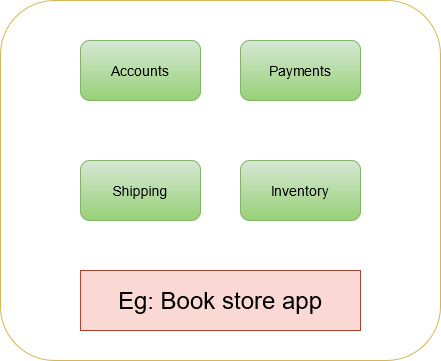
In a monolithic setup, these components are interwoven into a single application, deployed and scaled as one unit.
Advantages of Monolithic Architecture
- Simplicity in Development:
- A single codebase simplifies the development process.
- Testing and deployment are straightforward since all components are packaged together.
- Ease of Debugging:
- Centralized code makes it easier to debug and trace issues.
- Performance:
- Communication between components is faster since they reside within the same process.
- Mature Tooling Support:
- Decades of use have led to robust tools and Integrated Development Environments (IDEs) tailored for monolithic systems.
- Low Initial Cost:
- Fewer complexities mean lower initial development and infrastructure costs.
Disadvantages of Monolithic Architecture
- Scaling Limitations:
- Scaling a monolithic application involves replicating the entire application, even if only one component requires more resources.
- Single Point of Failure:
- A bug in one component can bring down the entire application.
- Technology Lock-In:
- Changes to the technology stack are challenging due to the tightly coupled nature of components.
- Slow Development Cycle:
- Adding new features requires extensive testing, as changes to one component might impact others.
- Deployment Challenges:
- Frequent deployments are impractical, as all components must be tested and deployed together.
Challenges of Monolithic Architecture
- Resource Scalability:
- Monolithic applications struggle to handle dynamic user demand effectively, leading to potential performance bottlenecks during traffic spikes.
- Complex Maintenance:
- Large codebases become increasingly difficult to maintain over time.
- Team Collaboration:
- As teams grow, working on a monolithic codebase can lead to bottlenecks, as multiple developers may inadvertently affect each other’s work.
- High Risk of Outages:
- Deployment or runtime errors in one module can lead to the failure of the entire application.
Monolithic Architecture vs. Microservices Architecture
| Aspect | Monolithic Architecture | Microservices Architecture |
|---|---|---|
| Codebase | Single, unified codebase. | Multiple independent services. |
| Scaling | Scale the entire application. | Scale individual services as needed. |
| Flexibility | Tied to a single technology stack. | Freedom to use different technologies per service. |
| Deployment | All-or-nothing deployment. | Independent deployment for each service. |
| Failure Isolation | Failure in one module impacts the entire system. | Failures are isolated to individual services. |
| Use Cases | Suitable for small, simple applications. | Ideal for large, complex, and scalable apps. |
How Kubernetes Transforms the Paradigm
Kubernetes thrives in managing containerized applications, particularly microservices, by automating deployment, scaling, and management. While it is possible to run monolithic applications on Kubernetes, its true potential shines with microservices.
Kubernetes Advantages for Monolithic Apps:
- Improved Resource Utilization:
- Kubernetes can still distribute resources efficiently even for monolithic applications.
- Blue-Green Deployments:
- Simplifies testing new versions of a monolithic app.
- Autoscaling:
- Dynamically adjusts resources based on load.
However, breaking down a monolithic application into microservices is often recommended for better alignment with Kubernetes’ strengths.
Key Features of Kubernetes
- Automated Scaling:
- Horizontal Pod Autoscaler adjusts workloads based on demand.
- Self-Healing:
- Restarts failed containers and replaces unhealthy nodes automatically.
- Declarative Configuration:
- Infrastructure and applications are defined as code for consistency and reproducibility.
- Multi-Cloud Support:
- Runs seamlessly across on-premises and public clouds.
- Service Discovery:
- Automatically assigns IPs and DNS names to services.
Advantages of Kubernetes for Modern Applications
- Increased Agility:
- Speeds up development cycles with CI/CD pipelines.
- Scalability:
- Scales resources horizontally and vertically as needed.
- Cost-Effective:
- Optimizes resource usage, reducing operational costs.
- High Availability:
- Ensures application uptime with built-in failover mechanisms.
Disadvantages of Kubernetes
- Complexity:
- Steep learning curve for new users.
- Resource Intensive:
- Running Kubernetes itself requires significant resources.
- Configuration Overhead:
- Managing manifests, Helm charts, and YAML files can become cumbersome.
Conclusion
Monolithic architecture has served the software industry well for decades, but it has its limitations, especially in the era of cloud-native development. Kubernetes offers a modern approach to application management, excelling in microservices architecture while still supporting monolithic applications.
Transitioning to Kubernetes unlocks scalability, flexibility, and automation, making it a must-have for organizations seeking to modernize their infrastructure. While monolithic architecture is still relevant for small-scale applications, embracing Kubernetes and microservices is key to thriving in today’s dynamic tech landscape.
For more insights:
- Explore Kubernetes best practices: Kubernetes Official Documentation
- Learn more about microservices: Microservices Guide
- How to run kubernetes cluster