

Virtualization vs Cloud Computing
Introduction
In today’s rapidly advancing technological landscape, cloud computing and virtualization are two of the most significant concepts shaping IT infrastructure. Although they are often interrelated, they serve fundamentally different purposes. Understanding their differences is crucial for businesses seeking to optimize their IT environments and leverage the right tools for scalability, efficiency, and cost-effectiveness.
This article provides a detailed comparison of cloud computing and virtualization, their roles, benefits, and how they complement each other in modern IT infrastructure.
What is Cloud Computing?
Cloud computing refers to the delivery of computing resources—such as storage, processing power, and applications—over the internet on a pay-as-you-go basis. It eliminates the need for businesses to maintain physical hardware or software, allowing them to focus on operations while accessing highly scalable and flexible resources.
Key Features of Cloud Computing:
- On-Demand Resources: Resources can be provisioned as needed.
- Centralized Management: All resources are managed in a centralized manner by the cloud provider.
- Pay-as-You-Go Pricing: Users pay only for the resources they consume.
- Accessibility: Resources are accessible via the internet, enabling remote work and global collaboration.
Examples of Cloud Computing Providers:
What is Virtualization?
Virtualization is the underlying technology that enables cloud computing. It involves creating virtual versions of physical components, such as servers, storage, or operating systems, through the use of a hypervisor. This allows multiple virtual machines (VMs) to run on a single physical machine, each operating independently.
Key Features of Virtualization:
- Hypervisor: A software layer that enables the creation and management of virtual machines.
- Hardware Optimization: Maximizes the utilization of physical hardware.
- Disaster Recovery: Provides isolated environments, reducing the risk of failure affecting other systems.
- Types of Virtualization: Includes hardware virtualization, application virtualization, desktop virtualization, and network virtualization.
Examples of Virtualization Tools:
Virtualization vs Cloud Computing: A Detailed Comparison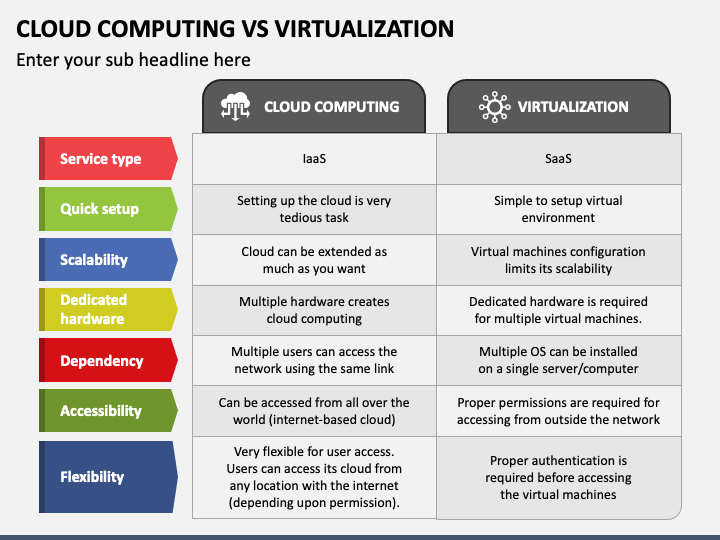
1. Purpose
- Cloud Computing: Designed to provide pooled, automated resources that users can access on demand.
- Virtualization: Focused on creating virtual environments within a physical system for optimized resource usage.
2. Setup Complexity
- Cloud Computing: Requires complex setup involving network configurations, resource allocation, and security management.
- Virtualization: Simpler to set up compared to cloud computing, as it primarily involves installing a hypervisor on existing hardware.
3. Scalability
- Cloud Computing: Highly scalable, allowing organizations to instantly add or reduce resources as demand changes.
- Virtualization: Limited scalability, as it depends on the physical hardware capacity.
4. Flexibility
- Cloud Computing: Offers extensive flexibility, supporting dynamic workloads and changing business needs.
- Virtualization: Less flexible than cloud computing, as it relies on the capabilities of the underlying hardware.
5. Disaster Recovery
- Cloud Computing: Relies on multiple servers and data centers for redundancy and recovery, ensuring minimal downtime.
- Virtualization: Disaster recovery depends on a single physical machine or peripheral device, making it less robust.
6. Workload State
- Cloud Computing: Workloads are stateless, meaning they can be stopped and resumed on different machines without retaining their state.
- Virtualization: Workloads are stateful, retaining their state and configurations during operation.
7. Cost
- Cloud Computing: More expensive due to the continuous usage charges and additional costs for scalability.
- Virtualization: Generally cheaper, as it leverages existing hardware and involves no ongoing subscription fees.
8. Hardware Requirements
- Cloud Computing: Requires extensive infrastructure with multiple dedicated servers.
- Virtualization: Can operate effectively with a single physical machine.
9. Storage Capacity
- Cloud Computing: Provides virtually unlimited storage capacity.
- Virtualization: Limited by the physical server’s storage capabilities.
10. Types of Services
- Cloud Computing: Includes services such as SaaS (Software as a Service), PaaS (Platform as a Service), and IaaS (Infrastructure as a Service).
- Virtualization: Includes Hardware Virtualization and Application Virtualization.
11. Configuration
- Cloud Computing: Configuration is typically image-based, allowing rapid deployment.
- Virtualization: Configuration is template-based, focusing on pre-defined settings.
12. Server Utilization
- Cloud Computing: Consolidates server usage to optimize resource efficiency across multiple users.
- Virtualization: Operates servers on demand based on specific requirements.
13. Pricing Model
- Cloud Computing: Follows a pay-as-you-go model, with charges based on resource consumption.
- Virtualization: Costs are tied to infrastructure investments and one-time licensing fees.
Conclusion
Both cloud computing and virtualization are essential to modern IT infrastructure, but they serve different purposes:
- Cloud Computing: Ideal for organizations needing scalable, flexible, and cost-efficient resources without the need to invest in physical infrastructure. It’s perfect for dynamic workloads and businesses prioritizing accessibility and global collaboration.
- Virtualization: Best suited for businesses that want to maximize the efficiency of their existing hardware. It offers cost-effective solutions for disaster recovery, resource optimization, and creating isolated virtual environments.
Understanding the differences allows organizations to strategically implement these technologies, leveraging their strengths to meet specific business needs. For optimal results, many organizations adopt a hybrid approach, combining both virtualization and cloud computing to create a robust, scalable, and efficient IT environment.
Learn about Virtualization in Cloud Computing